| a. |
Distinguish
between simple harmonic motion and periodic motion, giving an example for
each of them. |
3
marks |
| |
|
|
|
Simple harmonic motion is a special type of
periodic motion. In simple harmonic motion, the acceleration a is
always pointed towards a fixed point and is directly proportional to the
distance x from that point, i.e. it has to follow strictly the following
equation:
 |
1 |
|
e.g. simple pendulum, floating cylinder, mass-spring
system, etc. |
1 |
|
All types of motion that repeat itself after
a certain time interval is called periodic. |
|
|
e.g. bouncing ball, fans/motor, tides, clock
etc. |
1 |
| |
|
|
| b. |
State
Hooke’s Law and explain the physical meaning of the force constant k of
a spring. |
2
marks |
| |
|
|
|
Hooke's Law |
|
|
The extension or compression of a spring is proportional
to the force acting on it, provided the deformation is small. |
1 |
|
Mathematically, |
|
|
 |
|
|
where k is called the force constant of the spring. |
|
|
The force constant indicates the stiffness of the spring.
A larger force constant requires a larger force to cause the same deformation. |
1 |
| |
|
|
| c. |
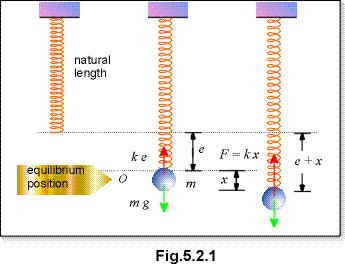
A
mass m is attached to the lowest end of a vertical spring suspended from
a fixed point. Find an expression for the extension of the spring when
the mass is at equilibrium. If the mass is pulled downward through a distance
A and is released, describe the subsequent motion of the mass. Write down
mathematical expressions for the displacement, velocity and acceleration
of the mass in terms of time t. State the phase relationship between the
three quantities. |
5
marks |
| |
|
|
|
 |
1 |
|
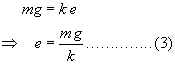
At equilibrium, the forces acting on the mass
are balanced: |
|
|
 |
1 |
|
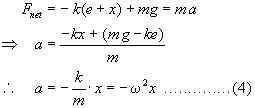
Suppose the mass is at a distance x
below the equilibrium position O. Taking downward positive, the
acceleration is given by |
|
|
 |
1 |
|
 |
|
|
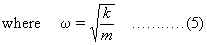
At t = 0, the displacement is the largest
(x = A). Thus, the initial phase is f
= 0. |
|
|
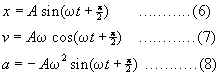
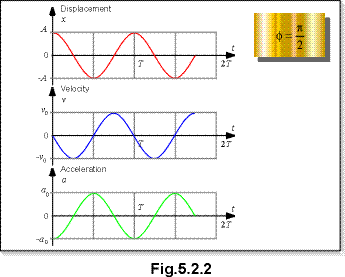
The equations for displacement, velocity and
acceleration are as follows: |
|
|
 |
1 |
|
a leads v by p/2;
v leads x by p/2. |
0.5 |
|
 |
0.5 |
| |
|
|
| d. |
In most
oscillators, the form of energy is continuously changing between kinetic
and potential. Explain the physical meaning of the potential energy in
the vertical vibrating system described in (c). With the aids of mathematical
expressions, describe how the energies of the mass vary with the position
of the mass. |
2
marks |
| |
|
|
|
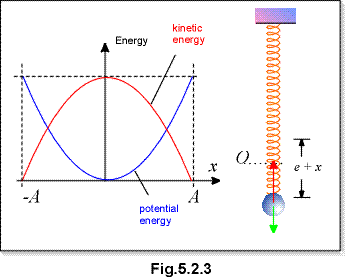
In the vertical mass-spring system, the potential
energy includes both the elastic p.e. and gravitational p.e. At the lowest
and highest points, the potential energy sum is the greatest. At the lowest
point, the p.e. exists in the form of elastic. At the highest point, the
p.e.exists mainly in the gravitational form. |
0.5 |
|
It can be proved that the p.e. sum is
 |
0.5 |
|
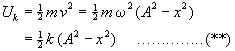
and the kinetic energy is |
|
|
 |
0.5 |
|
Thus, the p.e. is smallest at x = 0
and the maximum at x = A or x = -A. The maximum p.e. is |
0.5 |
|
 |
|
|
 |
|
|
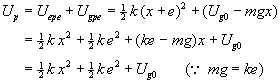
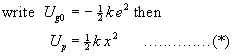
[Proof (not required)] Equation for p.e.
sum
Take the gravitational p.e. at the equilibrium position to be Ug0. |
|
|
When the displacement is x below O,
the p.e. sum is |
|
|
 |
|
|
 |
|
|
[Proof (not required)] Equation for k.e. |
|
|
From equations (6) and (7), |
|
|
 |
|
|
Thus, the kinetic energy for any value of x
is |
|
|
 |
|
| |
|
|
| e. |
Describe
how the kinetic energy and potential energy of a mass performing simple
harmonic motion vary with time t. Assume that the mass passes through the
equilibrium position at t = 0. Explain qualitatively why the kinetic energy
varies at a frequency different from the displacement. Sketch graphs to
illustrate your answers. |
4
marks |
| |
|
|
|
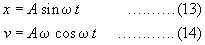
Since the particle passes through O
at t = 0, the equations for displacement and velocity are |
|
|
 |
|
|
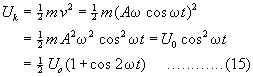
The kinetic energy at time t is |
|
|
 |
1 |
|
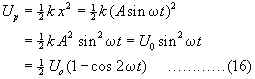
The potential energy at time t is |
|
|
 |
1 |
|
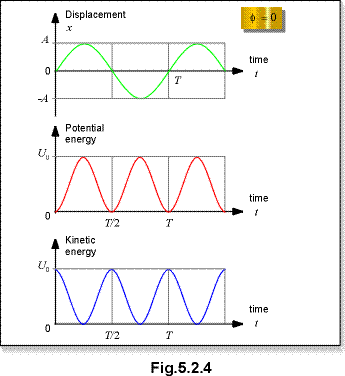
The k.e. of the particle varies at twice the
frequency as its displacement. |
|
|
This is because the particle passes through
the equilibrium position twice in each cycle. |
1 |
|
 |
|
|
|
|