| a. |
Define
simple harmonic motion. |
2
marks |
| |
|
|
|
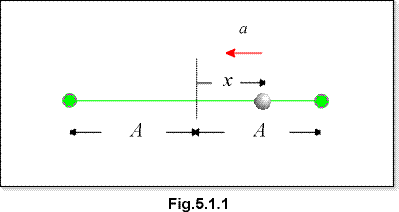
Simple harmonic motion
(SHM) is defined as the motion of a particle whose acceleration a
is always directed towards a fixed point and is directly proportional to
the distance x of the particle from that point. |
1 |
|
Mathematically,
 |
0.5 |
|
where w is a constant
called angular frequency. |
|
|
 |
0.5 |
| |
|
|
| b. |
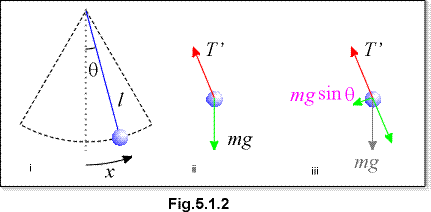
A
pendulum consists of a weight suspended vertically by a string, of length
l, attached to a fixed point. The weight is raised to one side through
a small distance and is released. Show that the motion is simple harmonic.
State the initial phase and write down expressions for displacement, velocity
and acceleration of the weight after time t. |
5
marks |
| |
|
|
|
 |
1 |
|
Consider the force tangent to the circular path. |
|
|
When the displacement is q,
the tangential component of the resultant is |
|
|
 |
0.5 |
|
For small amplitude (e.g. A < 10o), |
|
|
 |
0.5 |
|
So, (1) becomes |
|
|
 |
0.5 |
|
The displacement of the particle measured along the arc
length is |
|
|
 |
|
|
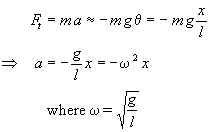
Thus, the equation of motion is |
|
|
 |
1 |
|
This shows that the motion is simple harmonic. |
|
|
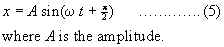
Since the particle starts with the largest displacement,
the initial phase is f = p/2. |
|
|
the displacement equation is |
|
|
 |
0.5 |
|
the velocity equation is |
|
|
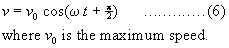 |
0.5 |
|
the acceleration equation is |
|
|
 |
0.5 |
| |
|
|
| c. |
Suggest
an experiment to demonstrate that the motion of such a simple pendulum
is simple harmonic. |
5
marks |
| |
|
|
|
 |
1 |
|
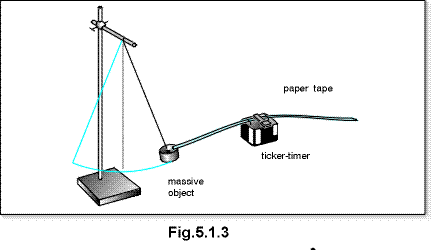
Hang a heavy mass vertically by a string. Attach
a paper tape to it. Mark the position of the timer stylus when the mass
is hung vertically. This shows the equilibrium position. |
0.5 |
|
Raise the mass to the left side. Start the
timer and release the mass. Stop the timer when the mass reaches to the
left side. |
0.5 |
|
Plot a x-t graph: |
|
|
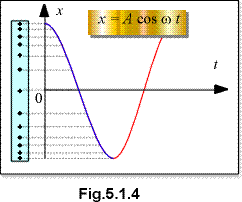 |
1 |
|
From the slope of the x-t graph, plot
the v-t graph: |
|
|
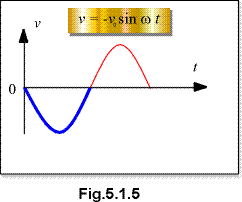 |
0.5 |
|
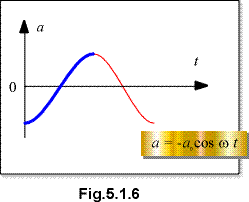
From the slope of the v-t graph, plot
the a-t graph: |
|
|
 |
0.5 |
|
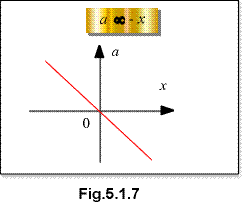
Plot a against x: |
|
|
 |
0.5 |
|
If the graph is a straight line as shown in
Fig.5.1.7, then the motion of the simple pendulum is verified to be simple
harmonic. |
0.5 |
| |
|
|
| d. |
Explain
how the acceleration due to gravity can be obtained from the result of
your experiment, stating the possible errors. |
4
marks |
| |
|
|
|
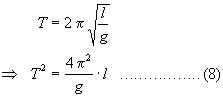
The period of a simple pendulum is |
|
|
 |
1 |
|
Using various length l. Time the period
T. Tabulate T2 against l. |
1 |
|
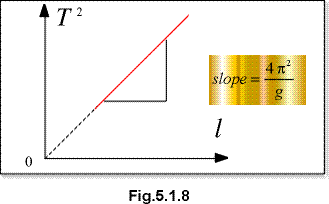
Plot a graph of T2 against
l : |
|
|
 |
1 |
|
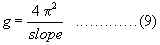
The acceleration due to gravity can be obtain
from the slope: |
|
|
 |
1 |