| a. |
The
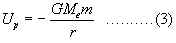
gravitational potential energy of a mass m above the Earth’s surface and
at a distance r from the Earth’s center is given by

State the significance
of the negative sign in the above equation by referring to the potential
energy when the value of r is very large. |
1
mark |
|
|
|
|
The gravitational potential energy for a system
of two masses is defined as zero at infinity, where the force between them
is zero. |
|
|
Since the gravitational force between masses
is attractive, to separate the masses to infinity requires work done on
the system. Thus, for any finite separation, the stored energy is less
than that at infinity, i.e. the gravitational potential energy is negative. |
|
|
In simple terms, the negative sign in the given
equation indicates that the force between the Earth and any mass is attractive. |
1 |
|
|
|
| b. |
Derive
an expression for the total energy of a satellite revolving round the Earth
in a circular orbit of radius r. Using your result, describe how the motion
of the satellite varies if there is net energy loss. |
5
marks |
|
|
|
|
Suppose a satellite is orbiting in a circle with radius
r at a speed v around the Earth (mass Me
and radius Re). The gravitational force accounts fully
for the centripetal force: |
|
|
 |
1 |
|
The kinetic energy of the satellite is |
|
|
 |
1 |
|
The gravitational p.e. of the satellite is |
|
|
 |
1 |
|
The total energy of the satellite includes both its k.e.
and p.e. |
|
|
 |
1 |
|
When there is net energy loss, U decreases. This
requires r to decrease. |
|
|
i.e. the satellite falls towards the Earth. |
|
|
As r decreases, from equation (1), v increases. |
|
|
i.e. the satellite moves faster as it falls towards the
Earth. |
1 |
|
|
|
| c. |
Explain
why an astronaut inside a space shuttle coasting in a circular orbit round
the Earth has a feeling of weightlessness. Compare this to
i)
a passenger inside an aeroplane which is moving parallel to the Earth’s
surface. |
6
marks |
|
|
|
|
The astronaut is performing circular motion
with the shuttle. His weight accounts fully for the centripetal force: |
|
|
 |
1 |
|
Since circular motion is an unbalanced motion,
the weight needs not be balanced. Besides his weight, there is no other
forces acting on the astronaut. i.e. there is no force between the astronaut
and his seat, sometimes even no contact. |
|
|
In fact, we feel our weight because there is
a reaction force (normal contact force) between our body and the ground
we stand or the chair we sit. If such a force vanishes, we would feel weightless. |
1 |
|
|
|
|
i) Although an aeroplane
also moves round the Earth, its motion is different from that of a space
shuttle. The speed of aeroplane is relatively very slow. The centripetal
force is almost zero. Therefore, the vertical forces are balanced. In fact,
the weight of an aeroplane flying horizontally is balanced by the lift
of the air, which can be explain by using the Bernoulli's principle. |
1 |
|
The weight of a passenger inside the aeroplane
is balanced by the normal contact force with his chair. |
1 |
|
|
|
|
ii)
an explorer inside a spaceship coasting in a straight line on leaving the
Solar system, many decades from now. |
|
|
|
|
|
A spaceship moving in the outer space is free
from any gravitational force. |
1 |
|
The explorer is actually weightless. |
|
|
There is no any force acting on the explorer. |
1 |
|
|
|
| e. |
Derive
an expression for the speed vr of a satellite revolving round
the Earth in a circular orbit near the Earth’s surface, in terms of the
Earth’s gravitational field strength and its radius. Discuss how the path
of the orbit varies when the launching speed is different from vr. |
4
marks |
|
|
|
|
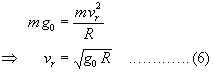
Suppose a satellite of mass m is revolving
round the Earth near the surface. The weight of the satellite is mgo,
where go is the gravitational field strength on the Earth's
surface. |
|
|
The centripetal force is fully provided by
the weight:
|
|
|
where R is the Earth's radius. |
|
|
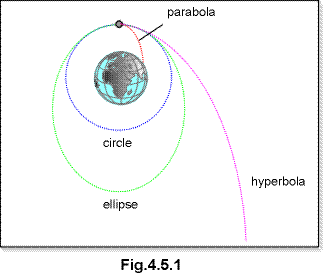
The four possible paths are |
|
|
-
parabola for v < vr.
-
circle for v
= vr
-
ellipse for vr
< v < ve, where ve is the escape
speed.
-
hyperbola for v > ve,
where ve is the escape speed.
|
|
|
 |
|