| a. |
The
weight of an object on the Earth is the gravitational pull of the Earth
on the object. Explain why a spring balance does not faithfully indicate
the weight of the objects near the equator, no matter how precise the spring
balance is. Discuss how the weight of an object varies as the object is
moved from the equator to one of the poles. |
5
marks |
| |
|
|
|
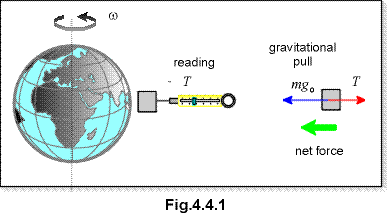
All objects on the Earth are performing circular
motion, i.e. the net forces of all objects are non-zero. The net force
(also called centripetal force) is the difference between gravitational
pull and the force of support. |
1 |
|
In the case of a spring balance hanging a mass,
the force of support (namely, the tension) is provided by the spring balance. |
|
|
 |
1 |
|
In the above diagram, the object is hung at
the equator:
 |
1 |
|
Thus, the spring balance cannot give exactly
the gravitational pull. |
|
|
From equation (1), the centripetal force is
smaller for smaller radius of path. As an object is moved from the equator,
the radius of path decreases. |
1 |
|
Thus, the centripetal force is smaller as the
object is moved to the pole, i.e. the difference between tension and the
gravitational pull is decreased. |
|
|
Hence, the reading in the spring balance increases
as the object is moved to the pole. |
1 |
| |
|
|
| b. |
With
the aid of a diagram, illustrate how the string that suspends a mass freely
at latitude q deviates from the line joining the mass and the Earth’s center.
On your diagram, clearly indicate the resultant force acting on the mass. |
4
marks |
| |
|
|
|
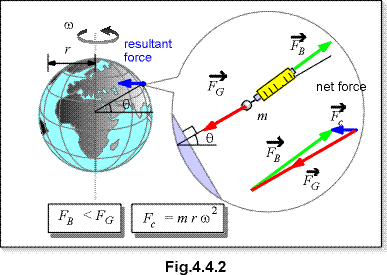
The gravitational pull FG is always pointing
towards the Earth's center. |
1 |
|
The direction of the tension FB in the
string acts such that the vector sum of FB and the gravitational
pull FG is pointing to and at right angle to the Earth's
axis. |
1 |
|
 |
2 |
| |
|
|
| c. |
State
the definition for the Earth’s gravitational field strength g. Explain
how the value of g varies with the distance from the Earth’s center, stating
any necessary assumptions. |
4
marks |
| |
|
|
|
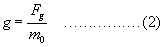
The Earth's gravitational field strength is
the gravitational force acting on any object per unit mass of the object: |
|
|
 |
1 |
|
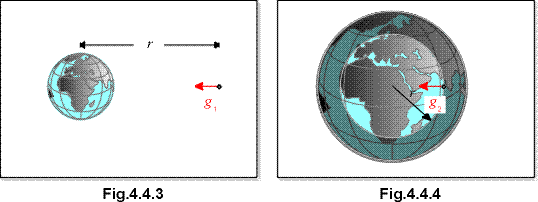
Outside the Earth (Fig.4.4.3) |
|
|
 |
|
|
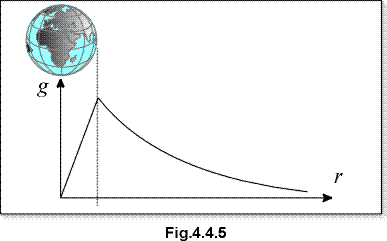
The Earth can be regarded as a point mass at
the centre. Thus the field strength is |
|
|
 |
1 |
|
Below the Earth (Fig.4.4.4) |
|
|
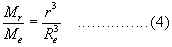
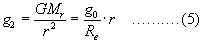
The effective mass of the Earth that attract
any mass is the smaller sphere: |
|
|
 |
|
|
Thus, the field strength inside is |
|
|
 |
1 |
|
Graphical representation |
|
|
 |
1 |
| |
|
|
| d. |
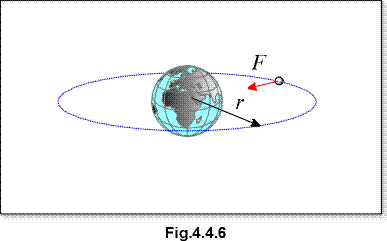
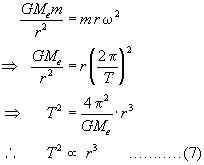
For
a satellite revolving round the Earth in a circular orbit of radius r and
with period T, show that r3 = kT2 where k is a constant. |
3
marks |
| |
|
|
|
 |
|
|
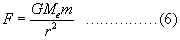
At the orbit of radius r, the gravitational
force acting on the satellite of mass m is |
|
|
 |
1 |
|
For circular orbit, this force is exactly the
centripetal force |
|
|
 |
2 |
|
|
|