| a. |
Write
down a definition for the gravitational potential energy of a mass at a
distance r from the Earth’s center in terms of the work done on the object,
stating how the zero potential energy for a system of masses is defined.
No mathematical proof is required. |
3
marks |
| |
|
|
|
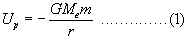
The gravitational potential energy of an object
is defined as the negative of the work done by the gravitational force
as the object moves from infinity to that point. |
1 |
|
 |
|
|
where Me is the mass of the
Earth, m is the mass of the object. |
1 |
|
At infinity the gravitational potential energy
is zero. |
1 |
| |
|
|
| b. |
What
do you understand about the gravitational potential of a planet? Draw a
circle to represent a planet and roughly sketch five equipotentials round
the planet, the potential difference between any two adjacent equipotentials
being a constant. |
4
marks |
| |
|
|
|
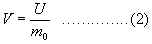
The gravitational potential at a point is defined as the
gravitational potential energy per unit test mass. |
1 |
|
 |
1 |
|
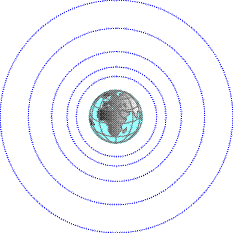
Since U varies with 1/r, when r is
small, a small change in r leads to a large change in U.
Thus, the equipotential lines are more denser near the Earth surface. |
1 |
|
 |
1 |
| |
|
|
| c. |
Derive
an expression for the speed of a satellite revolving round the Earth in
a circular orbit in terms of the Earth’s gravitational field g0
on the Earth’s surface, the radius of the Earth, Re, and the
radius of the circular orbit, r. Discuss how the launching speed of a satellite
varies with radius of the orbit. Hence, explain why the planets in the
Solar System are not moving in perfect circles round the Sun. |
6
marks |
| |
|
|
|
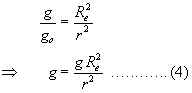
The gravitational field strength varies inversely
with the square of the distance from the Earth center:
 |
1 |
|
Thus, the field strength at the orbit of radius
r is given by |
|
|
 |
1 |
|
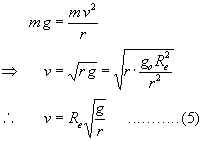
The speed of satellite at the orbit of radius
r is given by |
|
|
 |
1 |
|
From equation (5), the launching speed v
varies inversely with the square root or r, i.e. The smaller is
the radius, the larger is the launching speed. |
1 |
|
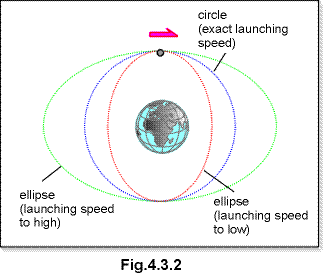
For an orbit to be circular, the launching
speed must satisfy exactly equation (5). If the speed is too high or too
small, the orbit may be an ellipse. This is why most of the planets in
the Solar System are not moving in perfectly circular path round the Sun. |
1 |
|
 |
1 |
| |
|
|
| d. |
Give
three examples of applications of satellites. |
3
marks |
| |
|
|
|
Three examples of applications: |
|
|
-
Communication satellites are used to relay information from a transmitter
to a receiver on the other part of the Earth
-
Weather satellites orbit round the Earth and transmit detailed pictures
of cloud patterns for use in weather forecasting
-
Survey satellites are low orbit satellites used in taking pictures
of the Earth surface for analysis of plantation.
(others: spy satellites for surveillance, military satellites for attacking/protecting
etc.) |
3 |
|
|
|
|
|
|
|
|
|
|
|
|