| a. |
Objects
in the following situations are performing circular motion:
i)
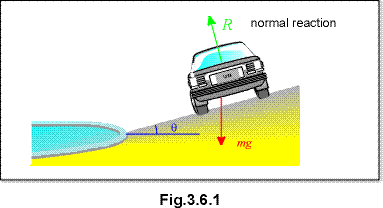
a car moving on a banked road at the designated speed of the road, |
6
marks |
|
|
|
|
 |
1 |
|
Since the car is moving at the designated speed,
there is no friction along the inclination. |
|
|
As the circular motion is horizontal, the centripetal
force is horizontal. This is provided by the horizontal component of the
normal reaction R with the road. |
1 |
|
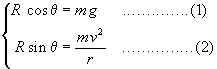
The appropriate set of equations is |
|
|
 |
1 |
|
|
|
|
ii)
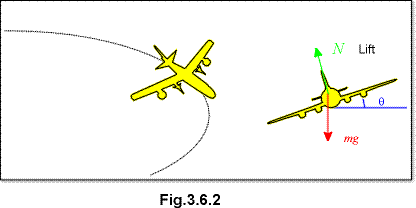
an aeroplane is moving in a curved horizontal path in air.
Draw diagrams to
show the forces acting on the car and the aeroplane. For each case, explain
the origin of the net force. |
|
|
|
|
|
 |
|
|
The lift is generated by the difference in
pressure above and below the wing. |
|
|
The horizontal centripetal force is provided
by the horizontal component of the lift N. |
|
|
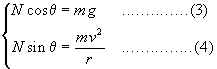
The appropriate set of equations is |
|
|
 |
|
|
|
|
| b. |
Explain
why a bicycle in a bend must tilt. Derive an expression for the angle of
tilt that the bicycle makes with the vertical. |
5
marks |
|
|
|
|
 |
1 |
|
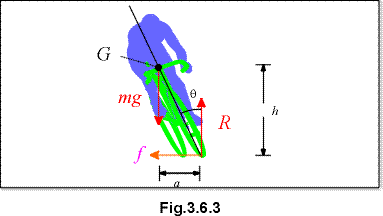
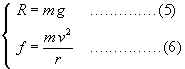
The diagram shows all the forces acting on
the bicycle. The centripetal force is provided merely by the static friction
f. The set of equations for the forces is |
|
|
 |
1 |
|
If the bicycle does not tilt, there would be
a net anti-clockwise moment about G. |
|
|
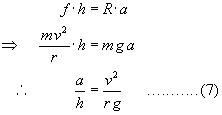
For motion without toppling, the angle of tilt
is given by setting the total moment about G to zero: |
1 |
|
 |
1 |
|
 |
1 |
|
|
|
| c. |
Explain
why a car turning round a bend will also tilt but in a direction opposite
to the bicycle in (b). |
5
marks |
|
|
|
|
 |
1 |
|
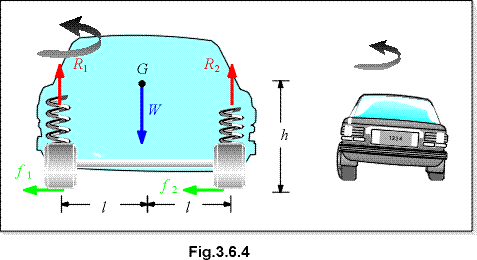
As the car is moving in a circular path, the
centripetal force is provided by the frictions in both tyres. |
|
|
 |
1 |
|
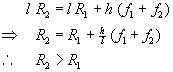
The total moment of the car taking about G
must be zero: |
|
|
 |
1 |
|
The suspension spring on the right is compressed
more. Thus, the car tilts to the right as it turns left as shown. |
1 |
|
|
|
|
Tilting of a car in a bend is different from
the tilting of a bicycle. That a car tilts is because the force acting
on the wheels are different. |
1 |
|
|
|