| a. |
Show
that an object in circular motion always requires an external force. Explain
why the work done by the external force, if any, does not change the energy
of the object. |
4
marks |
| |
|
|
|
The direction of an object in circular motion
is not constant. |
1 |
|
Its velocity is changing. The acceleration
is non-zero. |
1 |
|
By Newton's 2nd Law, an external force is required
to change the velocity. |
1 |
|
Since the directions of motion and the force
are at right angle, the work done by the force is zero. Thus, the energy
of the object is kept constant. |
1 |
| |
|
|
| b. |
Compare
the motion of a geosynchronous satellite moving at the same angular speed
as the Earth to that of a satellite receiver which is fixed on the Earth
but is also moving at the same angular speed as the Earth. |
4
marks |
| |
|
|
|
Both objects are performing circular motion with different
radii. |
0.5 |
|
Since the centripetal force is

the centripetal force required by the satellite is much greater than
that by the receiver. |
1 |
|
The centripetal force required by the satellite is fully
provided by the gravitational pull. |
1 |
|
Therefore, the satellite has to be placed in exactly the
distance from the Earth and projected with an exact speed. |
0.5 |
|
The centripetal force required by the receiver is provided
by difference between the gravitational pull and the reaction from the
Earth. The latter adjusts to a suitable value. |
1 |
| |
|
|
| c. |
Explain
why the water in a bucket whirled at a high speed in a vertical cycle does
not fall down. Derive the minimum speed of the bucket at the highest point
in order to keep the water inside. Express your answer in terms of the
radius of the circular path and the gravitational field strength. |
6
marks |
| |
|
|
|
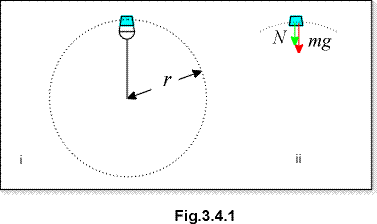
As the water is whirled in a vertical circle,
it requires a net force that points to the center everywhere. (If the speed
is low, at the highest point, the weight of water is more than required
and pours down.) If the speed is high enough, at the highest point, the
weight of water is less than the required centripetal force. The difference
is provided by the reaction from the bucket. Since there is contact between
the water and the bucket, water won't pour down. |
2 |
|
 |
1 |
|
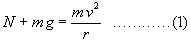
In the diagram above, the bucket is whirled
so that a normal reaction exists between the water and the bucket. The
net force acting on the water is N + mg. They together provide
the centripetal force when the speed of motion is v. |
1 |
|
 |
1 |
|
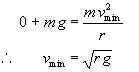
The minimum speed of motion is given by setting
N = 0. |
|
|
 |
1 |
| |
|
|
| d. |
If the
bucket in (c) is released suddenly, determine whether it is possible for
the water in the bucket to fall vertically. If your answer is yes, state
the position of the bucket where it is released, otherwise, explain carefully. |
2
marks |
| |
|
|
|
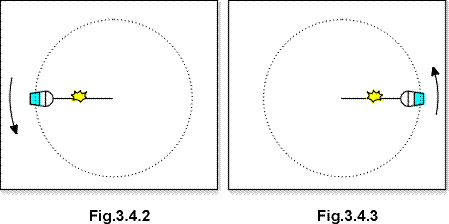
Yes. The following are two possible situations: |
|
|
 |
1,1 |
|
When the string connecting the bucket is released,
the bucket would move initially tangent to the circular path. In either
case above, they move vertically. |
|