| a. |
Without
using mathematics, explain why the net force acting on an object moving
in a circular path is non-zero, showing that the net force always directs
towards the centre of curvature. |
4
marks |
| |
|
|
|
The direction of an object moving in a circular
path is always changing. |
1 |
|
Thus, the velocity of the object is always
changing. By definition, if there is a change in velocity, the acceleration
is non-zero. By Newton's 2nd Law, the net force is non-zero. |
1 |
|
|
|
|
Consider an object moving at a constant speed
in a circle. Since the speed is constant, there is NO component of force
along the tangent (otherwise, the speed would either increase or decrease). |
0.5 |
|
Thus, the net force must be along the normal. |
0.5 |
|
The net force must not point away from the
centre of curvature, otherwise, it will move away from the centre. In fact
the direction of motion bends towards the centre. Thus, the net force must
direct towards the centre of curvature. |
1 |
| |
|
|
| b. |
Discuss
how a car can turn round a bend on a level road. Hence, explain why a car
moving at an exceedingly high speed will easily cause accident. |
4
marks |
| |
|
|
|
 |
1 |
|
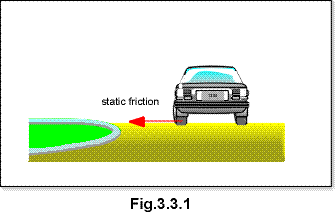
As a car turns round a bend on a level road, the centripetal
force is provided by the static friction between the tyre and the road
surface. |
1 |
|
Since the static friction has a limit depending on its
weight according to |
|
|
 |
|
|
where m is the coefficient of
static friction of the road. |
|
|
Without skidding, the friction is given by |
|
|
 |
1 |
|
Thus, if v is too large, the friction will not be
large enough to keep the circular motion. Skidding will occur. |
1 |
| |
|
|
| c. |
Suggest
how a spaceprobe coasting in the deep space can change its direction of
motion. |
2
marks |
| |
|
|
|
A spaceprobe coasting in deep space can change
direction by firing rocket at right angle to its motion. |
1 |
|
OR, by throwing away some objects at right
angle to its motion. |
1 |
| |
|
|
| d. |
A
stone on a planet is projected with a very high speed so that it goes round
the planet and returns to the starting position. Discuss how the stone
can be kept in circular motion without falling to the ground. Explain why
the speed of the stone does not increase in this motion. |
4
marks |
| |
|
|
|
The stone that moving round the planet is accelerating. |
0.5 |
|
This requires a net force, which is provided
by the weight of the stone. |
0.5 |
|
 |
1 |
|
The weight keeps changing the direction of
motion and so changes the velocity instead of causing it to fall down. |
1 |
|
The speed of the stone is not increased because
the force and the motion are at right angle. |
1 |
| |
|
|
| e. |
If the
stone in (d) is projected with a lower speed, give an account on its variation
in speed. |
2
marks |
| |
|
|
|
 |
0.5 |
|
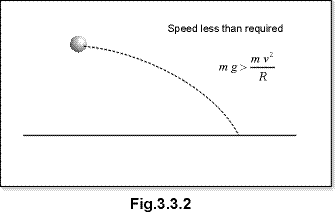
If the projection speed of the stone is not
as large as required, the path of motion is parabolic. |
0.5 |
|
It will be accelerated towards the ground,
i.e. the speed is increased. |
1 |
|
|
|