| a. |
Draw
complete force diagrams for all the underlined objects in the following
motions:
i)
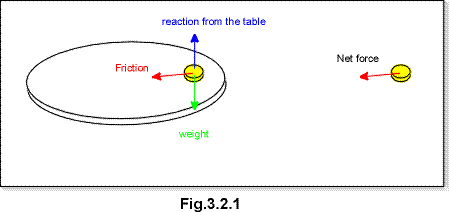
A coin is at rest on a rotating turntable, |
9
marks |
| |
|
|
|
 |
3 |
|
The net force acting on the coin is the static
friction between the coin and the turntable. |
* |
|
|
|
|
ii)
A ball suspended by a string performs horizontal circular motion,
while the string describes a cone, |
|
|
|
|
|
 |
3 |
|
The horizontal component of the tension in the string is
the net force acting on the bob. |
* |
|
|
|
|
iii)
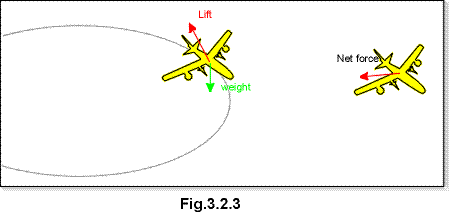
An aeroplane flies in a horizontal circle air-borne.
In each case, draw,
in a separate diagram, the net force acting on the object. |
|
|
 |
3 |
|
The horizontal component of the lift is the
net force acting on the airplane. |
|
|
|
|
| b. |
Explain
why objects at rest on the surface of the Earth near the equator are not
in equilibrium. Hence, give an account for the fact that the weight of
an object measured by a spring balance is not exactly equal to the gravitational
pull. |
4
marks |
|
|
|
|
 |
1 |
|
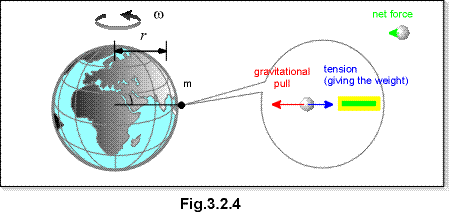
Consider a mass m suspended at rest
on the equator. Since the Earth is rotating, the mass is performing circular
motion about the Earth's axis. |
1 |
|
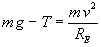
A net force (the centripetal force) is required
for the circular motion. This is the difference between the gravitational
pull and the tension: |
|
|
 |
1 |
|
The tension which gives the "weight" is less
than the gravitational pull. |
1 |
|
|
|
| c. |
Show
that the ideal banking angle of a bent road is independent of the mass
of the vehicles. |
3
marks |
|
|
|
|
 |
1 |
|
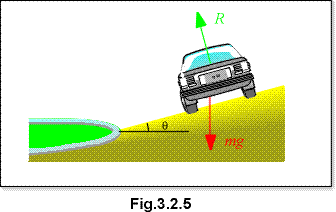
In an ideal banked road, friction is not required
for the circular motion. The centripetal force is provided by the horizontal
component of the reaction R. |
|
|
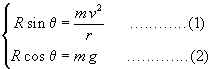
The vertical forces are balanced. Thus, we
have |
|
|
 |
1 |
|
Comparing (1) and (2), we have |
|
|
 |
1 |
|
Thus, the banking angle is independent of the
mass m of the vehicle. |
|