|
a.
|
A
particle is moving at a constant speed v in a circular path of radius r.
Derive expressions for
i) the
angular displacement in a given time interval, Dt, |
8
marks |
|
|
|
|
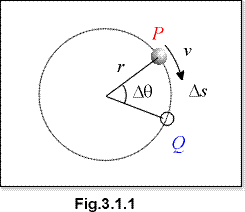
Suppose the particle moves from P to Q in Dt. |
|
|
 |
1 |
|
The distance travelled is
 |
1 |
|
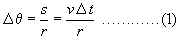
The angular displacement is
 |
1 |
|
|
|
|
ii)
the angular speed, |
|
|
|
|
|
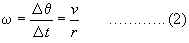
The angular speed is
 |
1 |
|
|
|
|
iii)
the centripetal acceleration. |
|
|
|
|
|
 |
2 |
|
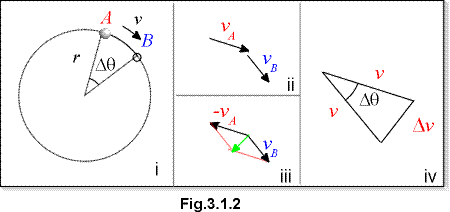
Suppose the particle moves from A to B in Dt. |
|
|
The velocity vector changes from  to
to  . . |
|
|
The change in velocity is
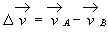
as shown in Fig.iii. |
1 |
|
For small angle Dq,
 |
|
|
Thus, the acceleration is

or
 |
1 |
|
From Fig iii, the direction of this acceleration
points towards the center. |
|
|
|
|
| b. |
Describe
an experiment to verify the expression for the centripetal acceleration,
stating the necessary equations for any motions involved. |
8
marks |
|
|
|
|
 |
2 |
|
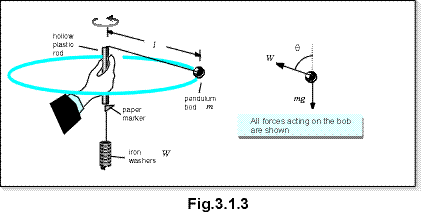
Attach a pendulum bob to some iron washers
through a string that passes through a hollow plastic tube. |
1 |
|
Put a paper marker on the string somewhere
above the iron washers. |
|
|
Swing the plastic tube. Increasing the speed
of the swing until the paper marker is just below the tube. |
1 |
|
Count the number of turns n. Then measure
the mass of the iron washer W and the length l. |
1 |
|
Repeat the experiment for different values
of l and W. |
|
|
If the theory is correct, the horizontal component
of the tension in the string provides the centripetal force:
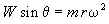
where W being the weight of the iron washers is also the tension
in the string,

 |
1 |
|
Thus, we have
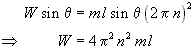 |
1 |
|
By comparing the quantity  with W, the equation for centripetal acceleration can be verified.
 |
1 |
|
|
|