| a. |
Define
work done, stating whether it is a scalar or a vector quantity. Give an
example for an applied force that results in negative work done on an object. |
4
marks |
|
|
|
|
The work done by a force acting on a
body is the energy transfer given by the product of the force and the distance
moved by its point of application in the direction of the force. |
1 |
|
 |
|
|
Referring to the above diagram, the work done
by the force is |
|
|
 |
1 |
|
Work done is a scalar quantity. |
0.5 |
|
An example of negative work done is lowering
a block: |
0.5 |
|
 |
1 |
|
Since the applied force is in opposite direction
to the motion, the work done is negative. The g.p.e. of the block is taken
away by the boy. |
* |
|
|
|
| b. |
Identify
the difference between work done and energy. Hence, derive an expression
for the kinetic energy of a moving object. |
4
marks |
|
|
|
|
Work done is the energy transfer. It talks about the change
in energy. |
|
|
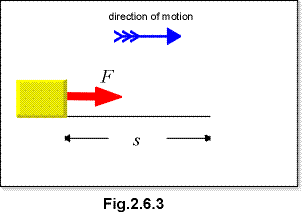
Consider a block of mass m pulled by a force F
through a distance s on a smooth ground, starting with speed u
and reaching at a final speed of v. |
|
|
 |
|
|
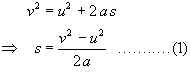
Let the acceleration be a. The distance travelled
is given by |
|
|
 |
|
|
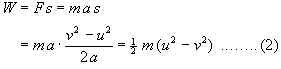
Since F = m a, the work done by the force
is |
|
|
 |
|
|
This represents the change in kinetic energy. |
|
|
Thus, the kinetic energy of the block is
 |
|
|
|
|
| c. |
Discuss
the energy change in the following processes:
i)
a proton is accelerated in an E-field, |
4
marks |
|
|
|
|
A proton moves from a higher potential to a
lower potential in an E-field. |
1 |
|
During its motion, the electrical potential
energy of the proton is converted into kinetic energy. |
1 |
|
|
|
|
ii)
a book is held stationary by a boy. |
|
|
|
|
|
Although the boy is using energy, this energy
does not go to the book. |
1 |
|
There is no work done on the book. |
|
|
The boy consumes energy which is eventually
converted into his internal energy. |
1 |
|
|
|
| d. |
Clearly
explain the difference in energy dissipation of a car in normal braking
and emergency braking, stating the force that decelerates the motion in
each case. |
4
marks |
|
|
|
|
In normal braking, the brake pad is rubbed
against the brake disc in the wheel. The kinetic energy of the car is converted
into internal energy of the brake pad and the brake disc. |
1 |
|
The force that causes deceleration of the car
as a whole is the static friction between the tyres and the road surface. |
1 |
|
In emergency braking, the wheels are locked.
There is no relative motion between the brake pad and the wheel. Instead,
relative motion occurs between the tyres and the road surface. The kinetic
energy of the car is converted into internal energy of the tyres and the
road surface. |
1 |
|
The force that causes deceleration of the car
is the kinetic friction between the tyres and the road surface. |
1 |