| a. |
State
Hooke’s Law and define the force constant k of a spring. Using a plot of
restoring force F against extension e, derive an expression for the elastic
potential energy stored in a stretched spring in terms of k and e. |
4
marks |
|
|
|
|
Hooke's Law:
The extension or compression of a spring is proportional to the force
acting on it, provided the deformation is small. |
1 |
|
 |
|
|
The proportional constant is known as force
constant, which can be defined as the force required to cause unit
extension/compression. |
1 |
|
The graph of applied force vs extension: |
|
|
 |
1 |
|
The area under the F-e graph represents
the worked done by the applied force. This increases the elastic p.e. (Ee)
of the spring. |
0.5 |
|
 |
0.5 |
|
|
|
| b. |
Derive
expressions for the force constants of two springs of equal length but
different force constants, k1 and k2, arranged
i)
in parallel, |
4
marks |
|
|
|
|
 |
|
|
The two springs have the same extension e. The restoring
force in spring 1 is |
|
|
 |
|
|
Similarly for spring 2: |
|
|
 |
|
|
The combination requires an applied force |
|
|
 |
1 |
|
By definition, the combined force constant is |
|
|
 |
1 |
|
|
|
|
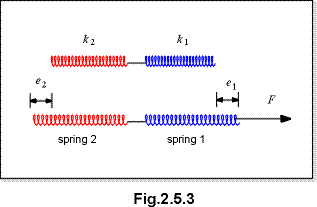
ii)
in series. |
|
|
|
|
|
 |
|
|
The same force F is applied on each
spring.
The extension in the spring 1 is given by |
|
|
 |
|
|
The extension in the spring 2 is given by |
|
|
 |
|
|
Thus, the total extension is the sum of e1
and e2. |
|
|
 |
1 |
|
By definition, the combined force constant
is |
|
|
 |
1 |
|
|
|
| c. |
Discuss
the energy change in each of the following motions:
i)
a block hung vertically by a spring from the ceiling is made to oscillate
up and down, |
4
marks |
|
|
|
|
As the block oscillates, it is instantaneously
at rest at the highest point and the lowest point and moves fastest when
it passes the equilibrium position. |
|
|
At the highest point, the block gains largest
gravitational potential energy. As it falls down, the spring sketches.
The g.p.e. changes into elastic p.e. and kinetic energy. The k.e. is largest
when the block passes through the equilibrium position. |
1 |
|
After passing through the equilibrium position,
the k.e. decreases and the elastic p.e. increases. At the lowest point,
the e.p.e. is the maximum. |
1 |
|
|
|
|
ii)
an elastic ball is released from a height above a horizontal ground and
bounces to the original level. |
|
|
|
|
|
The ball starts from rest, increases in speed
until it hits the ground. It is then at rest for a very short while. Immediately
afterwards its speed is restored but the ball moves upward until it is
at rest again at the highest point. |
|
|
When the ball is released, its gravitational
p.e. is the largest. The kinetic energy is zero. As it falls, the g.p.e.
falls while the kinetic energy increases. Before it hits the ground, the
k.e. is the largest. |
1 |
|
As soon as it hits the ground the k.e. is converted
completely into the elastic p.e. of the ball (causing deformation).
After a short while, the elastic p.e. is converted completely
into k.e. again. The ball then moves up converting k.e. into g.p.e. |
1 |
|
|
|
| d. |
Discuss
whether the following situations are possible or not, giving examples to
support your answer:
i)
an object with non-zero net force is moving at a constant speed, |
4
marks |
|
|
|
|
Yes, it is possible. |
1 |
|
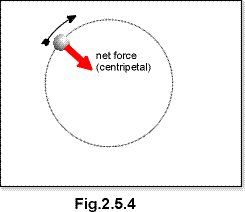
An example is circular motion. |
1 |
|
Although the speed is constant, the direction
is changing continuously. Thus, the velocity is changing. i.e. the acceleration
is non-zero. A net force is required. |
0.5 |
|
 |
0.5 |
|
|
|
|
ii)
an object changes speed while its acceleration is instantaneously zero. |
|
|
|
|
|
This is impossible. |
1 |