| a. |
State
the three origins of force, giving an example for each of them. |
3
marks |
|
|
|
|
The three origins of force are |
|
|
-
Gravitational force
e.g. weight of object on the Earth
-
Electromagnetic force
e.g. electrostatic force that attracts dust on TV screen and the magnetic
force which causes the motion of a motor
-
Nuclear force
e.g. the force that binds the nucleons of an atom together
|
3 |
|
|
|
| b. |
Discuss
the cause of friction between two bodies in contact, explaining clearly
the dependence of friction on the normal contact force and area of contact. |
2
marks |
|
|
|
|
Friction is caused by the electrostatic attraction between
atoms on the two surfaces. |
0.5 |
|
Friction increases linearly with the normal contact force.
This is reasonable because the normal contact force increases the interaction
between the atoms. |
0.5 |
|
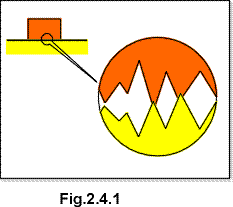
Since the surfaces are never flat but are highly irregular,
there are only very small amount of molecules joined together. The number
of joints depends on the normal contact force but is independent of the
area of contact. |
0.5 |
|
 |
0.5 |
|
|
|
| c. |
Illustrate
how the friction between a block on a rough horizontal plank varies with
the applied force on the object. Hence, discuss the motion of the block
if the plank is tilted gradually from its horizontal position. |
4
marks |
|
|
|
|
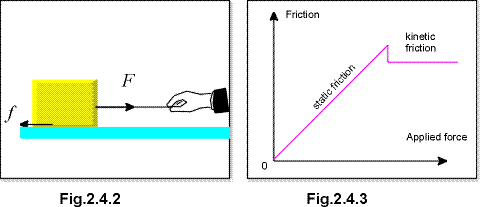
Consider a block being applied with a horizontal
force: |
|
|
 |
1 |
|
As the applied force increases, the friction
increases. Before the limiting value is reached, the friction is equal
to the applied force. The block is at rest and the friction is static. |
|
|
As soon as the block starts motion, the friction
is kinetic, which is usually smaller than static friction. Kinetic friction
depends on the normal contact force only. |
1 |
|
When a block is placed on an inclined plane,
initially the friction is large enough to balance the weight down the plane,
i.e.
 |
1 |
|
When the limiting angle is reached, the block
starts sliding down. Since kinetic friction is less than the limiting static
friction i.e.
 |
|
|
Thus, the block accelerates downward. |
1 |
|
|
|
| d. |
Discuss
the roles play by friction in a car during acceleration, normal braking
and emergency braking with skidding. Discuss the use of anti-lock braking
system normally equipped in modern cars. |
3
marks |
|
|
|
|
When a car accelerates, the wheels turn faster
so that the tyres exert a backward force on the ground. Thus causes a static
friction pointing forward. Thus, the static friction acts as a propelling
force. |
1 |
|
In normal braking, the wheels turn slower.
This results in a static friction, pointing backward, between the tyres
and the ground. Thus, the static friction acts as a retarding force. |
0.5 |
|
In skidding, the wheels are locked. The friction
between the tyres and the ground is kinetic and points backward, retarding
the motion. |
0.5 |
|
Since kinetic friction is less than static
friction, locking the wheels is undesirable. Anti-lock braking system is
to avoid locking. When the system senses that the wheels are locked, it
releases the brakes and then applies the brakes again. |
1 |
|
|
|
| e. |
Discuss
the importance of tyre threads in a car. Explain the dangers of using tyres
without tyre threads on wet roads. |
3
marks |
|
|
|
|
Tyre threads are useful when the road is wet. |
1 |
|
The zigzag channels are used to pump water
out behind as the wheel rolls over ponds of water on the road. |
1 |
|
If the tyre has no threads on it, a film of
water between the road and the tyre would build up. |
0.5 |
|
This reduces the friction so that skidding
would occur. |
0.5 |