| a. |
Define
impulse, stating its unit. Explain why a car should be designed with collapsible
front and rear parts and a rigid compartment. |
4
marks |
|
|
|
|
Impulse is defined as the product of a force
F and the time t for which it acts. By definition, it is
also equal to the change in momentum of the object concern (usually during
a collision). |
1 |
|
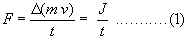
In a car collision, given an impulse J,
the force of impact is equal to
 |
1 |
|
The force depends on the time of collision.
The shorter is the time, the larger is the force. |
|
|
To reduce injury, the force is reduced by increasing
the time of collision. This is why the car is designed with collapsible
front and rear parts. |
1 |
|
The rigid compartment is important to protect
the passengers from being compressed. |
1 |
|
|
|
| b. |
In
terms of impulse, explain why a car with an air bag which inflates during
collision may help to reduce injuries. |
2
marks |
|
|
|
|
The air bag acts as a cushion between the driver and the
driving wheels. It lengthens the time of collision by its flexible volume. |
|
|
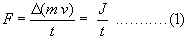
Since the impulse of the passenger in a collision is fixed,
increasing the time of impact decreases the force (and reduce injuries)
according to
 |
|
|
|
|
| c. |
Discuss
how a fast-moving base ball could be captured by a catcher with less pain.
Also discuss how a tennis ball could move off from the racket with a higher
speed. |
4
marks |
|
|
|
|
When a baseball is caught, its momentum falls
to zero, i.e. there is a fixed impulse. To catch the ball with less pain,
the catcher's and should retreat on holding the ball. This increases the
period for the momentum change and decreases the force. |
2 |
|
To strike a tennis ball, it is common for the player to swing the racket
backward and the swing forward to hit the ball. When the ball is hit, the
racket should be kept moving forward in a way to increase the time of impact. |
|
|
By J = F t, increasing the time of impact
for a given force would give the ball a greater momentum, i.e. a greater
speed. |
2 |
|
|
|
| d. |
Distinguish
between a head-on collision and an oblique collision. |
1
mark |
|
|
|
|
In a head-on collision, the line joining the
centers of the balls is parallel to the motion of the ball. After a head-on
collision, the balls move off along the line. |
1 |
|
After an oblique collision, the balls move
in different directions, in different angles with the line joining the
centers. |
|
|
 |
|
|
|
|
| e. |
Show
that a right-angled fork would occur in an oblique elastic collision involving
two identical masses, one of them being initially at rest. |
5
marks |
|
|
|
|
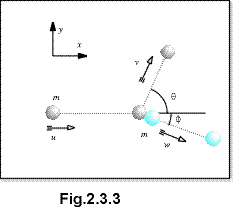
Consider a moving mass m striking on
a stationary identical mass obliquely with speed u. Suppose that
after the collision, the balls move off with speed v and w. |
|
|
 |
1 |
|
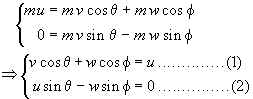
Apply the Law of conservation of momentum along
and perpendicular to the initial motion, we have |
1 |
|
 |
|
|
Squaring equations (1) and (2) and adding them
together:
 |
1 |
|
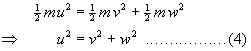
Next, consider the conservation of energy, |
1 |
|
 |
|
|
Comparing the results in (3) and (4), the middle
term on the right side of equation (3) must be zero, i.e.
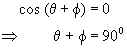
Thus, the colliding masses move off at perpendicular directions. The
resulting path is known as "right-angled fork". |
1 |