| a. |
State
Newton’s 1st and 2nd Laws, giving a brief account on how they are related. |
4
marks |
|
|
|
|
Newton's 1st Law:
A body continues in a state of rest or uniform motion in a straight
line unless it is acted upon by external force. |
1 |
|
Newton's 2nd Law:
The rate of change of momentum of a body is proportional to and in
the same direction as the resultant force that acts on it. |
1 |
|
The mathematical form of Newton's 2nd Law is:
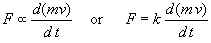
or F = m a, when k is set to 1 by definition. |
1 |
|
When an object is at rest or moving at a constant speed in a straight
line, its acceleration is zero (change of momentum is zero). According
to 1st Law, there is no external force. According to 2nd Law, the resultant
force is zero. Thus, the first law is a special case of the second law. |
1 |
|
|
|
| b. |
Explain
the meaning of inertia. |
1
mark |
|
|
|
|
Inertia of an object is its reluctance to change
in motion.
Therefore, a force is required to change its state of rest or state
of uniform motion. |
0.5 |
|
It depends on the quantity of substance in
the object. |
0.5 |
|
Mass is a quantitative measure of inertia. |
* |
| c. |
By
comparing the force required to project a mass horizontally on the surfaces
of the Earth and the Moon, distinguish between mass and weight. |
3
marks |
|
|
|
|
The weight of a mass on Earth is about six
times as that on the Moon. |
0.5 |
|
However, if the mass is projected horizontally
with the same speed, the force required on Earth is the same as that on
Moon. |
0.5 |
|
This is because the changes in momentum in
both cases are the same. The mass is independent of the gravity. It is
a measure of the amount of substance. |
1 |
|
The weight, which depends on the gravity g,
is related to the mass:
 |
1 |
|
|
|
| d. |
Discuss
the uses of seat belt and head restraint in a car. |
2
marks |
|
|
|
|
The seat belt is useful when the car stops
suddenly (e.g. crashing into a tree). |
0.5 |
|
It helps to pull the drivers/passengers backward
while their inertia keeps them moving forward. |
0.5 |
|
The head restraint is useful when the car is
pushed forward suddenly (e.g. collide from the back by a truck). |
0.5 |
|
It helps to support the head and neck which
would otherwise be thrown backward relative to the car. |
0.5 |
|
|
|
| e. |
Account
for the momentum change of the objects involved in following examples:
i)
a ball falls freely under gravity, |
6
marks |
|
|
|
|
A ball falling under gravity is accelerating.
Its momentum is increasing. |
|
|
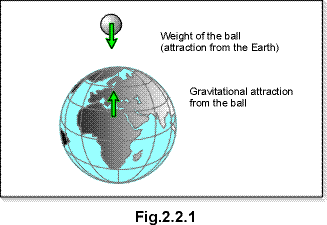
This is explained by the Earth's gravity: The
weight of the ball is the net force that causes momentum change. |
1 |
|
In order to apply the law of conservation of
momentum, the system of reference should consists both the ball and the
Earth. There is no external force. The weight on the ball and the gravitational
attraction on the Earth are internal forces. |
1 |
|
 |
1 |
|
|
|
|
ii)
a fast moving car is stopped by a strong rigid wall.
For each case, explain
how you should choose the system of reference in order to apply the law
of conservation of momentum. |
|
|
|
|
|
The momentum of the fast moving car drops to
zero suddenly by the rigid wall. |
|
|
This is because the wall exerts a large force
on the car, changing the car's momentum to zero. |
1 |
|
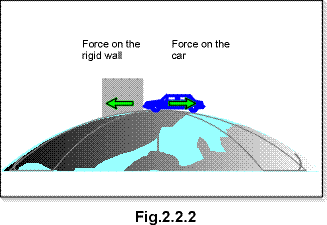
In order to apply the law of conservation of
momentum, the system of reference should consists both the car and the
Earth. During the collision, the car exerts a force on the Earth and the
Earth exerts the same force on the car in opposite direction. These forces
of impact are internal forces. There is no external force involved throughout. |
1 |
|
 |
1 |