| a. |
State
Newton’s 2nd and 3rd Laws and explain how the unit of force is defined. |
4
marks |
|
|
|
|
Newton's 2nd Law:
The rate of change of momentum of a body is proportional to and in
the same direction as the resultant force that acts on it. |
1 |
|
Newton's 3rd Law:
If one body exerts a force on another, there is an equal and opposite
force, called reaction, exerted on the first body by the second one. |
1 |
|
The mathematical form of Newton's 2nd Law is:
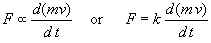
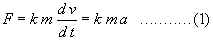
For constant mass m, we have
 |
1 |
|
The unit of force is defined as newton. One
newton of force (1 N) is the force acting on a mass of 1 kg and producing
an acceleration of 1 ms-2. Thus, k in equation (1) is
1. Or,
 |
1 |
|
|
|
| b. |
Using
Newton’s Laws, explain why the total momentum is conserved involving two
moving bodies in a collision. |
4
marks |
|
|
|
|
 |
1 |
|
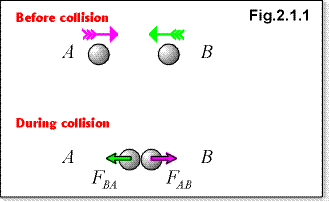
Consider the collision of two balls A
and B. During collision, they exert force on each other.
According to Newton's 3rd Law, the force that A exerts on B,
FAB, is the same as the force that B exerts on
A, FBA, but opposite in direction. |
1 |
|
Since force is the rate of change of momentum
(by the 2nd Law), the rate of change of momentum of ball A is equal
and opposite to that of ball B, i.e. the change of momentum of ball
A is equal and opposite to that of ball B. Mathematically,
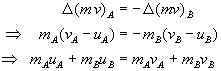
i.e. The momentum is conserved. |
2 |
|
|
|
| c. |
Compare
the propulsion by a jet engine and a rocket, stating one major difference
in application. |
2
marks |
|
|
|
|
A jet engine takes air from outside, burns
gas in the combustion chamber so that exhausted gas are ejected at high
speed backward. The propelling force is the reaction from the exhausted
gas. |
1 |
|
A rocket also makes use of the Newton's 3rd
Law by ejecting high speed exhausted gas. However, unlike a jet engine,
air is not taken from outside. Instead, a rocket brings along with oxygen
(in liquid form) so that oxidation can take place even when the rocket
is moving in the outer space. |
1 |
| d. |
Draw
individual force diagrams for all the objects mentioned in the following
situations:
i)
a person standing inside a lift that accelerates upward, |
6
marks |
|
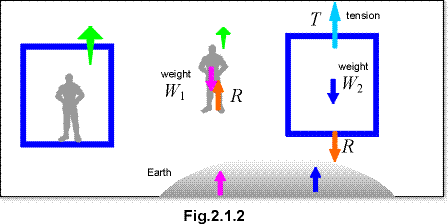
Consider a person of weight W1
in a lift of weight W2. |
|
|
 |
2 |
|
For the person, his weight W1
and his upward attraction force acting on the Earth form an action-reaction
pair. The reaction R from the floor and the downward force that
he acts on the lift form another action-reaction pair.
For the lift, its weight W2 and its upward attraction
force acting on the Earth form an action-reaction pair. The upward force
(pull from the cable) T and the downward pull on the cable (not
shown) form another action-reaction pair. |
2 |
|
|
|
|
ii)
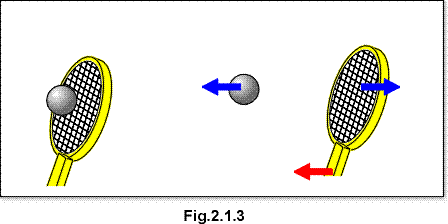
a tennis ball undergoes impact with a racket.
In each case, mention
the pairs of forces that constitute action-reaction pairs. |
|
|
|
|
|
 |
1 |
|
The forces that act between the ball and the
racket form an action-reaction pair. The force exerted by the tennis player
and the force acting on the tennis player by the racket form another action-reaction
pair.
(The weight of the ball and the weight of the racket are not mentioned.
They are similar to that in d.ii above.) |
1 |