| a. |
A
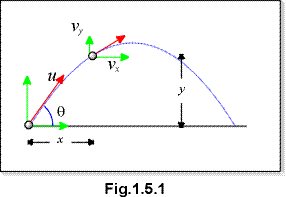
stone is projected from a horizontal ground with a velocity u, making an
angle q with the horizontal.
(a)
Show that the path of the stone in air is parabolic. |
4
marks |
|
|
|
|
 |
1 |
|
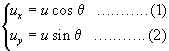
The initial horizontal and vertical components of
the velocity of the stone are:
 |
1 |
|
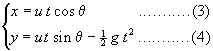
After time t, the horizontal and vertical displacements
are
 |
1 |
|
Eliminating t from equations (3) and (4), we have

Equation (5) is in the form of a parabola. Thus, the path of the stone
is parabolic. |
1 |
|
|
|
| b. |
Discuss
how the vertical and horizontal components of the speed of the stone vary
with time. Hence, find the range and the maximum height reached by the
stone. |
5
marks |
|
|
|
|
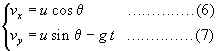
Since the gravity acts vertically downward, the horizontal
component of the speed of the stone is unchanged throughout the motion.
The vertical component decreases as the stone moves up and increases
as it moves down. Mathematically,
 |
1,1 |
|
The range of the stone is the maximum horizontal displacement.
This occurs when the stone hits the ground or when the vertical displacement
is zero.
The time of flight is given by putting y = 0 in equation (4):
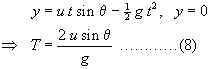
The horizontal range is given by putting t = T in equation (3):
 |
2 |
|
Maximum height is reached when the vertical component of
the velocity is instantaneously zero. The time for max. height is given
by putting vy in equation (7) to zero.
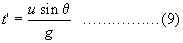
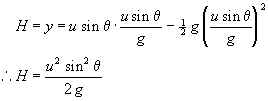
The maximum height is given by putting t = t' in equation (4):
 |
1 |
|
|
|
| c. |
Show
that there is another angle of projection for the stone to hit the same
target on the ground using the same speed of projection. Explain why the
times of flight using these two angles of projection are different. |
5
marks |
|
|
|
|
The range of a projectile using projection angle q
is
 |
1 |
|
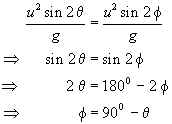
For the same range, let the other projection angle be f.
Then, we have
 |
2 |
|
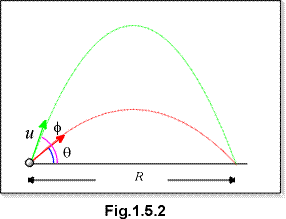 |
1 |
|
From equation (8), the time of flight is

which is determined by the projection angle. Since f
= 90o - q, the time of flight for
another projection angle is different. |
1 |
|
|
|
| d. |
With
a fairly accurate drawing, discuss how the direction with which the stone
hits the ground depends on the angle of projection. (No mathematical proof
is required.) |
2
marks |
|
|
|
|
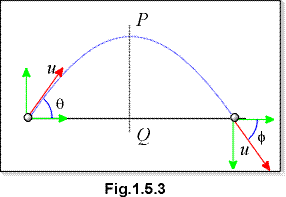 |
1 |
|
The path of the stone is parabolic. It is symmetrical about
the dotted line PQ. Thus, the angle at which the stone hits the ground
is the same as the angle of projection. |
1 |