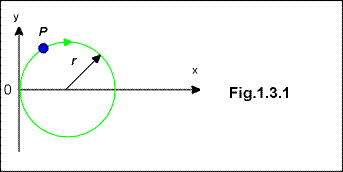
A
particle P moves at a constant speed v in a circular path of radius r as
shown.
i)
Write down expressions for the time to complete one cycle and the number
of cycles performed per unit time.
12
marks
The time for completing one cycle is the time to move through
2pr using speed v.
The number of cycles per unit time is the frequency. It is the reciprocal
of T.
2
ii)
At time t = 0, the particle passes through the origin O. Roughly draw the
following graphs for one complete cycle, taking into account the directions
of displacement:
(1) x-t graph,
(2) y-t graph.
In chapter 5 (Simple harmonic motion), you will learn that
the projection of circular motion on a diameter is simple harmonic motion.
SHM could be represented by either
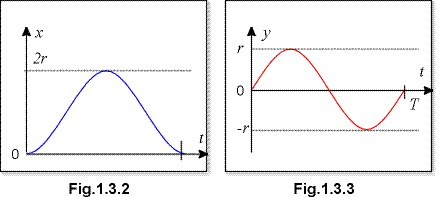
The projection of P on x-axis is represented by

This is because the motion starts from the leftmost side and at t
= 0 , x = 0.
The motion is graphically represented as shown in Fig.1.3.2.
1
2, 2
The projection of P on the y-axis is represented by
This is because the motion starts from origin and moves upwards. At
t = 0 , y = 0.
The motion is graphically represented as shown in Fig.1.3.3.
1
iii)
Consider the projection Q of the particle on the x-axis. Sketch a graph
of the speed of Q against time t for one complete cycle.
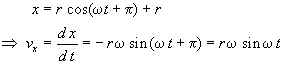
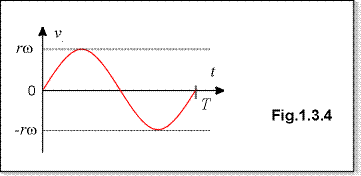
The velocity of Q can be given by the slope of the x-t
graph in Fig.1.3.2.
Alternatively, differentiate
The result is sketched as shown below:
2
2
b.
Ship
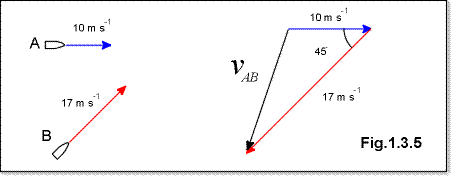
A moves due east at a speed of 10ms-1. Ship B moves in direction
N450E at a speed of 17ms-1. Sketch a diagram to show
the velocity of A relative to B. Insert suitable numerical quantities in
your diagram.
4
marks
2
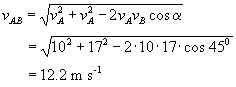
The velocity of A relative to B is
as shown in Fig.1.3.5