The Cassini MissionWhat We're LearningA page by Jeff Barnhart, Nathan Rigsby, Jaci Bartlemay, Matt Hahn, and Jenny Young |

|
The Cassini MissionWhat We're LearningA page by Jeff Barnhart, Nathan Rigsby, Jaci Bartlemay, Matt Hahn, and Jenny Young |
|
|
Saturn's Rings
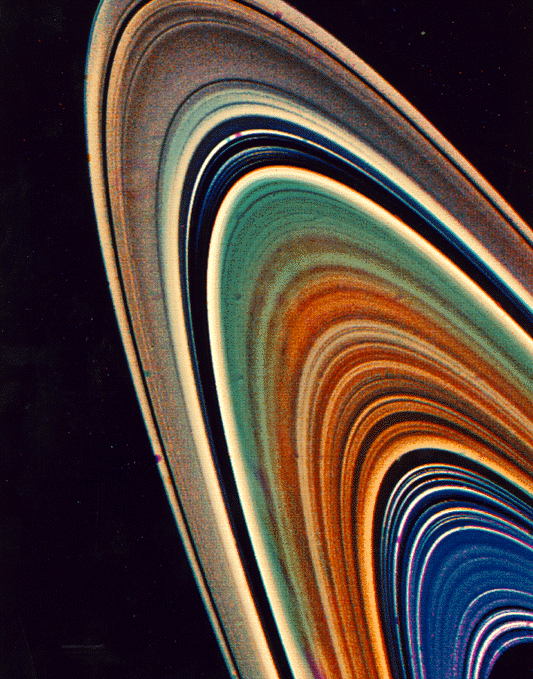
Scientists have known that the rings of Saturn contain water-ice, but the Ultraviolet Imaging Spectrograph
has given us more in-depth information about the materials in the rings. The pictures taken show that the further away from
Saturn, the purer the rings are. The rings closest to the planet are considered �dirty.� It has been known that there was
�dirt� within the rings, but it was not known that there was a distinction between the inner and outer rings. The ice in the
outer rings has been found to be purer than originally thought.
It is thought that the materials making the ice dirty are most likely silicates and organic materials like those that make
up the rocks and dirt on Earth. The dirt probably originated from meteors and broken-up moons and is thought to be similar
to the material found on Phoebe. There is also a concentration of dirt in the Cassini Division and the Encke gap. It is
also thought that the ice particles contain ammonia and other similar substances. Because the ring materials are not
thoroughly mixed they are unstable and scientists believe that the rings are fairly young.
In ultraviolet light, we can see variations in the water-ice on the rings� surfaces. These variations are caused by
collisions with meteorites. The variations are explained by the recent destruction of moons within the rings, which creates
wave action. This indicates that the material is continually cycling between rings and moon-like objects. Radio waves
transmitted during the mission contained musical tones created by the collisions between meteoroids and ice. Each collision
creates energy pulses from which the approximate diameters of the objects can be found.
The moons of Saturn create density waves in the rings. There are ripples in the waves cause by the moons� pull, mainly in
the Cassini Division. When they analyze these waves they can determine the size, mass, and velocity of ring particles.
There is also a stream of material between the F ring and the moon Prometheus. It seems that the moon is pulling material
from the ring creating a �streamer� of material. Similar wisps of material have been found protruding from the Keeler gap
which suggests to scientists that there may be a small moon nearby. It is suspected that it is no more than three miles or
so in diameter so it has not been seen yet but circumstantial evidence points to its existence. There is a possibility of
another small shepherding moon that may be creating a small gap in the rings that was unseen until Cassini.
There are still many questions surrounding the rings of Saturn. With the information and photographs from Cassini
scientists can finally begin making conclusions about the mysterious rings.
Saturn's Magnetosphere and Atmosphere


A planet's magnetosphere is the space around a planet that is controlled by the planets magnetic field. The magnetosphere of
Saturn is like any other magnetosphere, it acts as a deflector of solar wind. It is not as large as Jupiter�s but is still
very large, it could hold all of Saturn�s moons inside it. It is a very strong source of radio waves and it gives off a very
beautiful aura. Over half of the instruments on the Cassini space craft will help us study the tear-drop shaped
magnetosphere of Saturn. The tear-drop shape comes from the solar wind pushing the magnetosphere as it rushes by. There has
not been much information collected yet about the magnetosphere.
Saturn's atmosphere is composed mainly of molecular hydrogen and helium. The next most abundant material is sulfur, which
gives Saturn the yellowish color. Nitrogen and oxyen are also found. All of these molecules can combine to form the clouds
and smog seen on Saturn. The atmosphere is very thin when compared to the overall planet size. The thinner haze and smog
are found on the outer-most layer of the atmosphere, above three cloud decks. The Voyager probe made an indirect observation
of lighting in the mid-1980s. The Cassini mission made a direct observation of lighting in radio emissions in July. Much
disturbance has been detected in Saturn's atmosphere. Scientists use the same observation methods to watch Titan's
atmosphere.
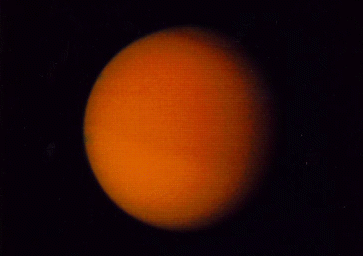

Saturn�s moon Titan is a very important element in the Cassini mission, because scientists believe that the moon resembles
what earth was like in its early stages of existence. Titan is the only moon in our solar system to have an atmosphere,
which leads scientists to believe that there might be some similarities between Earth and Titan. The Cassini mission will do
a total of 44 close fly-bys of Titan, while in the orbit of Saturn, to gather evidence of Titan�s surface and atmosphere and
possibly relate the information to Earth�s atmosphere. One similarity between the two atmospheres is that they have high
concentrations in nitrogen. Titan�s atmosphere is 95% nitrogen, and Earth�s is 78%. One difference between Titan�s
atmosphere and Earth�s atmosphere is that Titan�s atmosphere extends about ten times farther out into space than Earth�s
does. Titan�s atmosphere extends 600 kilometers into space, while Earth�s only extends 60 kilometers. Observations from a
ground - based telescope show that Titan has methane clouds near its south pole. This means that the weather cycle on Titan
could be similar to Earth�s weather cycle.
In January of 2005, the Cassini Orbiter will release a probe, called the Huygens Probe, into the atmosphere of Titan. The
Huygens probe will be able to send back data revealing the surface of the moon. The surface of Titan has been highly debated
for the last ten years, or so. What most scientists believe is that the surface is made of mostly water, but has one
continent sized region of land. This has been called Xanadu. The Huygens Probe is expected to land near this continent
sized region but not on it. NASA believes that the probe will be able to send back more data if it lands on water. This is
because, if the land on Titan is mountainous, then the chances of landing in an upright position are significantly lower. If
the probe lands in the water, it will be more likely to land upright and be able to communicate back with the Cassini
Orbiter. In addition, the Huygens probe has instruments that could capture the data from the water better than from the
land.
Titan is extremely important because it provides us with an example of how Earth�s characteristics might have been many
billions of years ago. We would be able to study how the atmosphere was created and how other characteristics of Earth
formed. This could also mean that life forms could exist on Titan. We would be able to study how life evolves and how Earth
has evolved through the ages.
The object of Cassini mission�s close encounter with Saturn�s moon, Phoebe, received images that were to one thousand times
more clear than pre-existing pictures of the moon. The spacecraft also collected other important information that gave
scientists some clues to the secrets of how the solar system was formed. Cassini flew past Phoebe at an astounding 2,000 km
in June of 2004. When compared to the 2.2 million kilometers of distance the Voyager 2 came to Saturn�s moon, this is a
major accomplishment. The Cassini spacecraft was also equipped with a superbly better-quality camera than the spacecraft
preceding it.
Prior to the actual mission, scientists hoped to find out several things concerning Phoebe. The low density was expected,
but they expected to receive information to help them find more information about the geology, history and structure.
Facts about Phoebe
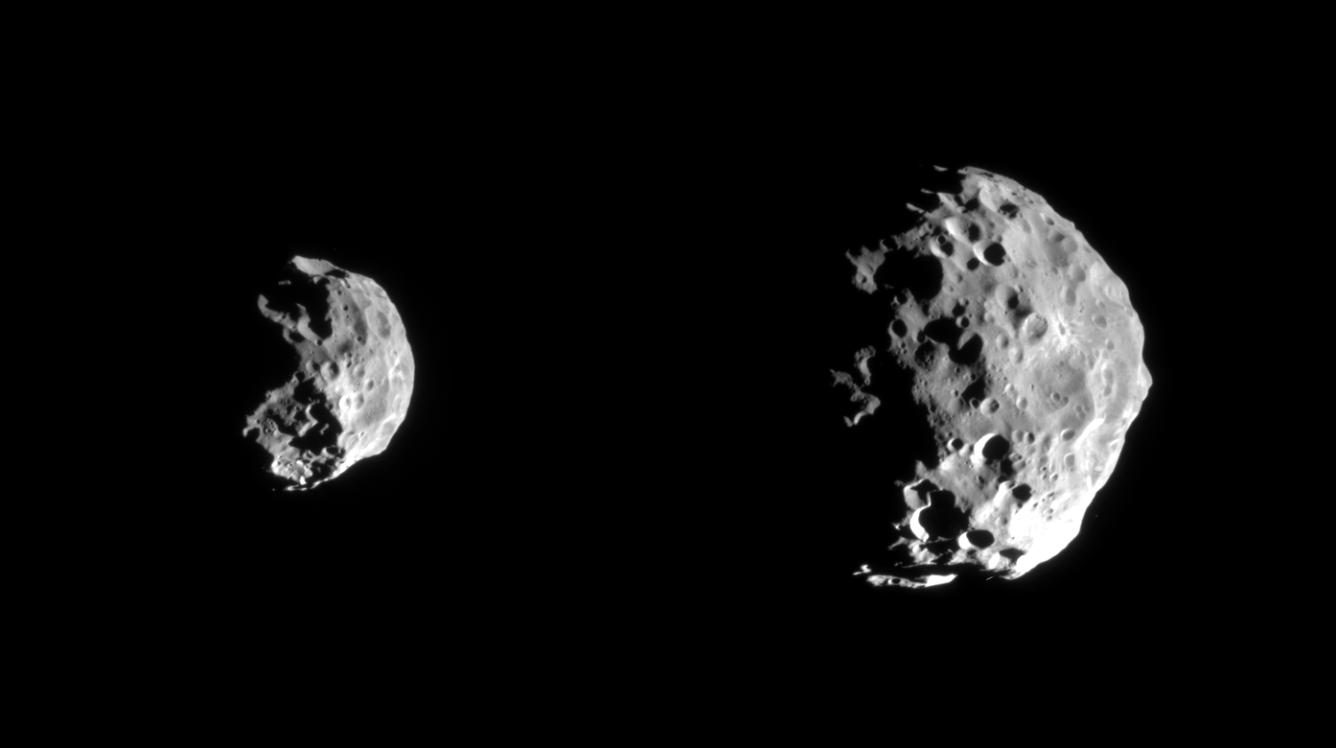
You can see the huge difference that a few hours� travel makes from these two pictures. They were both taken on June 10,
2004, but 13 hours apart. They depict opposite sides of the moon, but the second image is much more clear than the first.
These images also indicate a large variety in size of craters. There are cliffs created by the boundaries of these craters.
The images are enlarged a bit, but there was no contrast enhancement added.
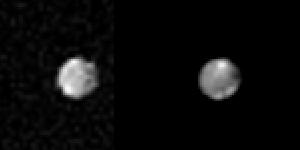
Here is a picture from Voyager 2�s mission past Phoebe. You can see the huge difference in resolution between this picture
and those from the Cassini mission. In another picture from the same site, Saturn is visible from Phoebe�s point of view.
There are a few points of light which represent some of the other moons of Saturn.
When Cassini reached a point in its travel that was close enough to Phoebe to take an accurate photograph (on June 11, 2004),
it took images that indicate to us the different minerals composing the make-up of the moon.
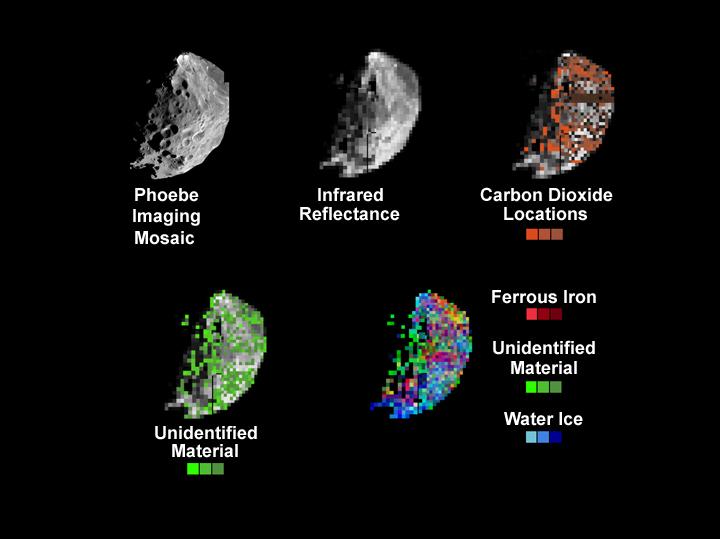
The large existence of carbon dioxide indicates to us that this moon most likely came from the colder regions of the Kuiper
Belt rather than the Asteroid Belt.