To predict the distance traveled by a golf ball, several things need to be known. Among those are: lengths of the club and arms, mass of the club, ball, and arms, and the angular velocity of the swing. Here are some of the givens (with reference in parentheses):
Length club = 43 in. = 3.58 ft. (http://www.clubmaker.net/length.htm)
Length arm = 25 in. = 2.08 ft. (measured)
Length club + arm = 3.58 ft. + 2.08 ft. = 5.66 ft.
Mass club = 315 g. = .0216 slug (Averaged mass http://www.golfclubreview.com/drivers.htm)
Mass ball = 46 g. = .00315 slug (http://hypertextbook.com/facts/ImranArif.shtml)
Mass arm = 3 lb. X 2 = .1863 slug (measured)
Angle(q)
club = 15o (measured)
Angle(f)
clubloft = 10o (http://www.clubmaker.net/loft.htm)
To determine the angular velocity of the swing, I timed a friend’s golf swing. The initial position of the swing is approximately 45o to the horizontal plane and ends approximately 180o to the horizontal plane. Therefore, the total angular distance of the swing is 360o + 135o = 495o. The average time of his swing was 0.40 sec. Converting degrees to radians, we determine the angular velocity to be:
w = 8.64 rad / .4 sec = 21.6 rad/sec
One of the equations that assists in determining the velocity of the ball is the coefficient of restitution:
e = (v ball(final) – v club(final)) / (v club(initial) – v ball(initial))
The only variable that we know is that of v ball(initial), which of course is 0. However, a simple experiment can be used to find the coefficient of restitution (http://www.racquetresearch.com/coeffici.htm):
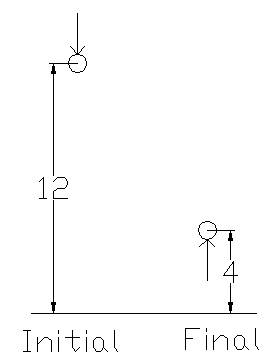
Here, I dropped a golf ball from a height of 12 inches onto the face of a typical driver. To be sure that the experiment would provide reliable results, the face had to be parallel to the horizontal plane. The ball consistently bounced back to a height of approximately 4 inches. Therefore, we can use this equation to determine the coefficient of restitution:
e = Ö(H final) / (H initial) = Ö(4/12) = .577
To determine v club(initial), we use the equation: v q = v p + w x L pq
v club(initial) = w x L club + arm = 21.6 * 5.66 = 122 ft / sec.
Now, we have two unknowns left, v ball(final) and v club(final). To determine these unknowns, we will present a second equation that involves these two variables:
I swing * w initial = I swing * w final + L club + arm * m ball * v ball(final)
First, however, we must calculate the inertia of the swing, where we generalize the club/arms system as a slender rod:
I = (1/3) * m rod * (L rod)2 = (.333)*(.2079)*(5.66)2 = 2.22 ft*lb*s2
Therefore, our equation becomes:
(2.22)*(21.6) = 2.22*w
final + (5.66)*(.00315)* v ball(final)
Adding to this, our equation from the coefficient of restitution:
e = (v ball(final) – v club(final))
/ (v club(initial) – v ball(initial))
.577 = (v ball(final) – 5.66*w
final) / (122)
Omitting the algebraic calculations, we determine that v ball(final) = 184 ft./sec.
Now, we must find the direction that the ball travels. If the clubface was parallel to the club shaft, we would have the ball lift at an angle of 15o since that is the angle that the club impacts the ball at. However, we must also include the 10o loft angle of the clubface, which makes the total angle of the ball flight equal to 25o.
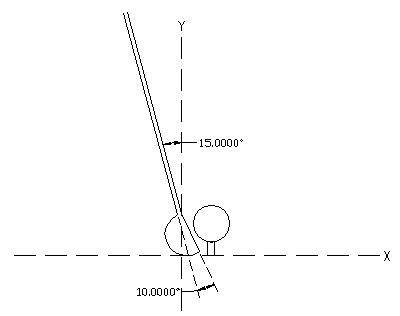
Therefore, our X and Y components of the ball’s velocity are:
vx = 184*cos(25o) =
167 ft/sec
vy = 184*sin(25o) = 77.8 ft/sec
We’re assuming that the course is flat. Therefore, the ball will travel a net vertical distance of 0 ft. Therefore, the upwards distance of the ball’s travel due to the impact of the swing will be nullified by the weight of the ball. This relationship will give us the total time of the ball’s flight:
vy*t = (1/2)*g*t2
77.8t = 16.1t2
77.8 = 16.1t
t = 4.83 sec.
Now we can determine the horizontal distance traveled by the ball:
vx*t = (167)*(4.83) = 807 ft. = 269 yards

| Home | Calculations | Conclusion |