




Nuclear Fission
Nuclear Fission, simply put, is a nuclear reaction in which an atomic nucleus splits into fragments. This is typically two fragments of comparable mass, and the release of 100 to several million volts of energy is also expelled. Nuclear Fission is typically caused by the bombardment of an atomic nucleus (such as Uranium) by neutrons.
For example :
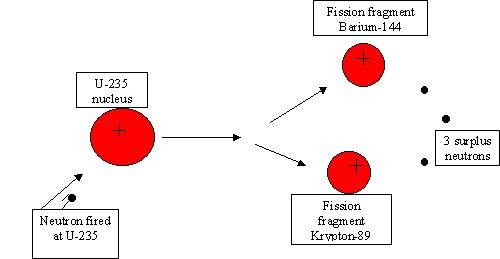
Figure 1.1 : Diagram showing the fission of U-235 into the fragments Barium and Krypton, as well as 3 surplus neutrons.
Stability
The determining factor on the stability of a nucleus arises from the forces that hold it together. Essentially the strong attractive nuclear force between protons and neutrons is resisted by the Coulomb repulsion between the positively charged protons. The balance between these forces determines the stability of the nucleus.
In an atom such as Uranium (an easily fissionable element), the nucleus can be split comparatively easily. Uranium's atoms are comparatively large compared to any other element in the periodic table.
Uranium can be found in two isotopes: U-238 and U-235. Typically U-238 compromises around 99.3% of naturally occurring Uranium, with U-235 around 0.7%. U-235 is by the far the most fissionable of the two due to the following reasons:
i) U-235 possesses fewer neutrons than U-238 (143 as opposed to 146). This will therefore mean that the Coulomb repulsion between the protons in the nucleus will not be as well compensated for by the strong nuclear force between the protons and the neutrons.
ii) U-238 acts as an excellent reflector of neutrons. This means that there is a smaller chance of a neutron being able to penetrate the nucleus and cause fission.
iii) Binding Energy (see below)
Binding Energy
The Binding Energy is a measure of the stability of a nucleus. Essentially, the higher the binding energy, the more stable the nucleus. Iron has the greatest binding energy of all the elements and as such is the most stable element.
Uranium has a particularly low binding energy, and as such is vunerable to fission. When a nucleus absorbs a neutron (as in a fission process) energy must be used to rearrange the nucleus into a stable state. If the energy to rearrange the nucleus is greater than the binding energy then the nucleus must either shed excess energy of fission.
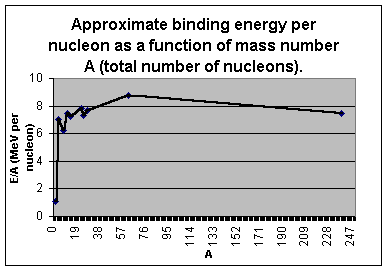
Figure 1.2 : Graph of binding energy per nucleon against mass number A (total number of nucleons).
In the case of U-238 an absorbtion of a neutron, and then the rearrangement of the nucleus leaves it with an excess of 1MeV, and as such will not fission. U-235, however, does not have such a deficit and such an absorption will cause the nucleus to fission.
Chain Reaction
The concept of a chain reaction is the main principle behind the enormous amount of energy released in nuclear fission. Essentially, the principle is that from each fission further neutrons will be released, which can subsequently cause further nuclei to fission. If on average at least one neutron is absorbed from each fission then a "self-sustaining" chain reaction can be produced. If on average more than one neutron goes on to produce further fissions then an exponential release of energy will occur.
The basic principle behind a nuclear device is to use an "uncontrolled chain reaction". Only physical constraints such as, the quantity of Uranium used, will harness the power of the device. Nuclear reactors use controlled nuclear fissions to provide the necessary energy release. Boron rods can be used to absorb excess neutrons and thus limit the rate of fission.
Energy Release
The explanation behind the amount of energy released in nuclear fission can be explained by the "binding energy" concept. The combined mass of the separate nucleons (protons and neutrons) which constitute the nucleus is greater than the actual mass of the nucleus. The difference between them is known as the "mass defect".
Through Einstein's famous equation E = mc2, using m as the mass defect it is possible to calculate E, as the binding energy of a nucleus.
The following example can be used to calculate the energy released in a fission process:
From figure 1.2 :
Binding
energy near A=240 as 7.6MeV
Binding energy near A=120 as 8.5MeV
This corresponds to (8.5 - 7.6) = 0.9MeV per nucleon increase in binding energy
(0.9 x 235) = 200MeV total increase per atom.
Fission releases around 20 million times more energy than an equivalent chemical reaction.