|
|
Short extract from page 7
It was a typical Sunday morning in Hawaii. The sun was shining brightly and there was a gentle breeze coming in off the blue Pacific. I finished my breakfast at about 0700 and was down in my compartment getting my bunk and other belongings shipshape. As I was not in the duty section I had plans to go ashore and enjoy a day at Waikiki Beach. My clean white uniform was nicely laid out on my bunk. What a day I had planned!
Downes was in dry dock for minor repairs with Cassin and battleship USS Pennsylvania (BB-38). The crew were scraping and painting the hull while the navy yard was replacing the tripod mast with a stick mast, placing extra shell plating forward, and doing some work on the stern and bearing strut. We had very little ammunition on board and were taking power and water from the dock.
The duty section was standing by Colors like all other ships in the harbor. The time was 0755. At 0756 the duty messenger came running down the main deck yelling, “All hands to general quarters. This is not a drill.” My first reaction was to think, “Lieutenant Parker is on duty and he has done it again.” He often held drills at the most inconvenient times so I took my time going topside. Then I saw a plane drop a torpedo and bank toward us. My second reaction was, “Somebody has gone mad. Why would the ‘airdales’ hold drills on Sunday morning?” Then reality hit me ‘right between the running lights’. That torpedo hit the battleship USS Oklahoma (BB-37) and exploded. When I had a second look at the plane I saw a big ‘red meat ball’. It’s hard to say what was going through my mind at the time. I was stunned to say the least. There wasn’t any need for me to go to my battle station as I was a torpedoman. We had a few rounds of small arms ammunition on board so I joined one of the machine-gun crews.
Short extract from page 17
The Battle off Bougainville
As we approached Rabaul from the east on 20 February, our fleet saw an enemy patrol plane. It wasn’t long before we found out that he had seen us too. We had almost finished our dinner when that dreaded general alarm button was pushed. I can assure you there is no sailor, no matter how slow or old he happens to be, who cannot run one hundred yards in ten seconds or less when he hears that alarm. The adrenaline starts pumping and the legs just will not stand still.
Within three minutes all battle stations were manned and ready. Then word came over the ship’s PA system that our task force had radar contact with enemy planes at 45 miles due east. As I sat there watching from my torpedo mount, straining my eyes to the limit, I began to re-live the experience of seeing those planes attacking at Pearl Harbor. Then I saw eight small dots in the sky. As they approached we could see our fighter planes swarming like hornets, over, under, and behind them.
With my eyes locked on those planes I think I started counting the seconds like a countdown before we would have to open fire. Then I noticed one of the enemy bombers losing altitude. His nose suddenly went seaward and smoke was flowing from his tail. In a few seconds he was literally torn to bits as he settled into a watery grave. That was number one for our fighter planes. On they came and still I sat there waiting and counting. “When will we open fire? Surely we aren’t waiting until we see the whites of their eyes?” Nobody can imagine how it felt to be in this situation unless they had been there.
Then all hell broke loose. The anti-aircraft guns started belching those projectiles into the sky. Then the shells began to burst throwing shrapnel in all directions. The 20mm, 40mm and 50 caliber machine guns opened fire. There was a steady stream of tracers guiding the gunners as they took aim at the enemy planes. The sky was full of bursting shells and I wondered how anything as big as a plane could get through all of that flak. Then the cease-fire order came. I don’t know how long the firing had lasted but it seemed like an eternity.
All ships came through our first encounter with the enemy in good shape. Eight enemy planes had gone to Davy Jones’s locker. I wondered if the rest had had enough. No, not yet. At 1730 it was back to battle stations to ward off another attack. Our guns needed more time to cool down, but time they did not have. Eight more planes came in. Once again the sky was filled with steel. Seven of them were shot down and one of our fighters was lost. The pilot bailed out and was picked up by USS Patterson (DD-392). Then I saw plane number eight head straight for Bagley and memories of Pearl Harbor flashed in front of me again. He was getting closer and closer. I could see those dreadful camouflage colors as he came on in a plunging dive toward us. I was on my torpedo mount and there was nothing I could do as I watched that monster of death coming. Should I run? Where to? Then I said to myself, “Gene, don’t lose your faith. You will come through it.” Our 20mm and 40mm guns were pumping a continuous stream of hot steel into that plane. It never pulled out of its dive and hit the water in a blaze of fire aft of our stern. Bagley was hit with a 20mm shell— one of our own—that went through the deck on the forecastle and I saw that one of our sailors, Seaman Peter Woodward, suffered a shrapnel-cut to his leg.
All of the attacking planes
had been shot out of the sky and many sailors were jumping up and down
cheering. Not long after this we were told that our surprise attack on
Rabaul had been canceled. You can certainly believe me when I say, “This
sailor, the sailors in Bagley, and those on the other ships were not shedding
tears.”
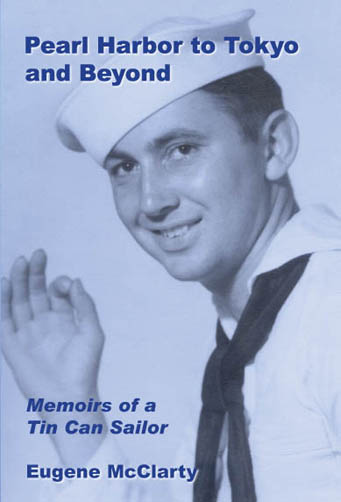
Gene in Brisbane, 1941
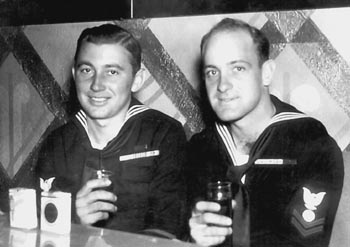
Gene and friend Busby, Sydney 1943
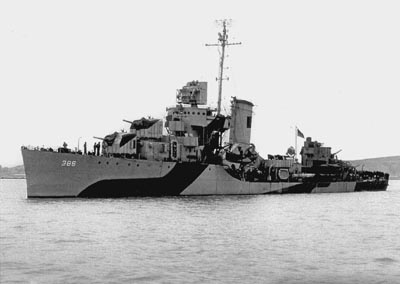
USS Bagley (DD386) in 1944
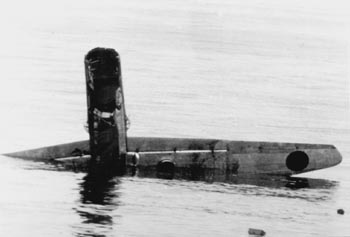
Splashed Jap 'Betty'