 |
 |
 |
| ERICKSON v. KNAPP 938 Federal Supplement 581 |
| Lawrence ERICKSON, Plantiff, (Photojournalist) v. Randall KNAPP and Thomas Hornsby, Defendants. (Sheriffs Deputies) No. SA CV 89-780 AHS (EEx). United States District Court, C.D. California, Southern Division. October 1, 1990 _________ |
| Plaintiff moved for summary adjudication when defendants claimed immunity from liability in an action arising out of defendants' seizure of plaintiff's camera. The District Court, Stotler, J., held that defendants were not entitled to immunity. Motion granted. Civil Rights - Fourth Amendment "Defendants were not entitled to immunity in action arising out of seizure of plaintiff's camera at scene of fire, despite defendants' claim of good faith belief in need to seize camera, where defendants did not claim probable cause for seizure of camera nor cite any other exception to Fourth Amendment's requirement of a warrant, and defendants' sole justification was that the seizure of camera would eliminate plaintiff's "interference." U. S. C. A. Const. Amend. 4." Stephen Yagman, Yagman & Yagman, Venice, CA, for plaintiff. Paul N. Paquette, Serritella & Paquette, Los Angeles, CA, for defendants |
| ORDER GRANTING PLAINTIFF'S MOTION FOR SUMMARY ADJUDICATION |
| STOTLER, District Judge. Plaintiff's Motion for Summary Adjudication came on regularly for hearing before the Court, the Honorable Alicemarie H. Stotler, District Judge, presiding. The issues having been duly argued by counsel, the Court ruled in accordance with its Tentative Ruling given to counsel prior to the hearing. The text thereof follows. The Court grants plaintiff's Motion for Summary Judgement. Defendants do not claim probable cause for the seizure of plaintiff's camera nor cite any other exception to the Fourth Amendment's requirement of a warrant. Defendants' sole justification is that seizure of the camera would eliminate plaintiff's "interference." Defendants' claimed "good faith" belief in the need to seize plaintiff's property at the scene of the fire cannot be upheld as reasonable as a matter of law. Fourth Amendment principles for circumstances permitting arrests and seizures were clearly established in July of 1989. "If the law was clearly established, the immunity defense ordinarily should fail, since a reasonable competent public official should know the law governing his conduct." Harlow v. Fitgerald, 457 U.S. 800, 818-819, 102 S.Ct. 2727, 2738. The Court modified, signed, and filed plaintiff's proposed Statement of Uncontroverted Facts and Conclusions of Law. IT IS SO ORDERED. |

|
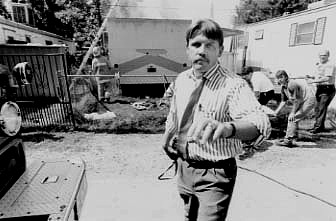
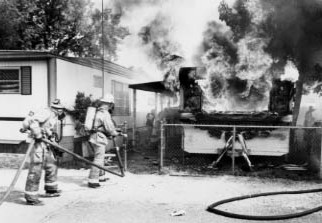
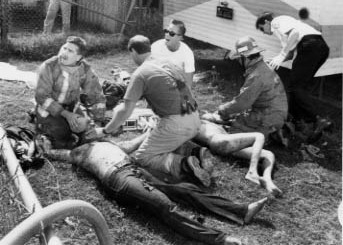
| These photographs appeared variously in The Sun newspaper -San Bernadino, Associated Press wire, News Photographer magazine, and a book on photojournalism ethics in a section dealing with police interference. |
| Federal Court Published Opinion - 4th Amendment |