"Great Zimbabwe"
Continue
Back
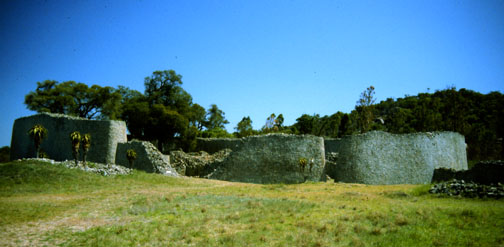
Located in the south central African nation of Zimbabwe are the ruins of monuments and cities built of stone. These ruins extend a radius of 100 to 200 miles, a diameter almost as great as the entire nation of France. Believed to have been built by southern Africans about 600-1,000 years ago, they are evidence of a thriving culture in the heart of Africa. Up until recent years, the ruins were believed by Western historians to be the remains of a "mysterious white race" in the heart of Africa. Great Zimbabwe has been ravaged by European treasure hunters and amateur archaeologists. Layer after layer of African artifacts were trashed in order to reach the bottom layer which, it was assumed, would prove that whites had exerted early influence in southern Africa. How many artifacts and important pieces of this ancient culture was lost is unknown. It is only in the last several of decades since Zimbabwe became independent in 1980 that archaeologists have begun to take a serious look at ruins of Great Zimbabwe and similar sites representing a dynamic social, economic and political culture in Southern Africa. Pictured above is the great walled enclosure of Great Zimbabwe. (Photo and information courtesy of MCC)
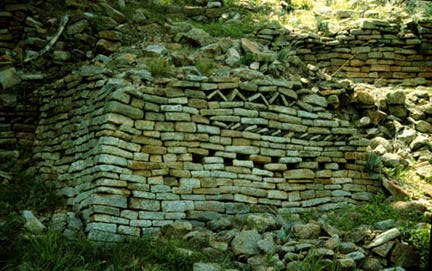
It is now generally accepted that the ruins of Great Zimbabwe reflect the culture of the Shona peoples, a Bantu speaking ethnic group, who reside in the region today. The name Zimbabwe comes from the Shona. Roughly translated it can mean "Houses of Stone" and are associated with rulership. Upon independence the newly formed state of Zimbabwe took this name for itself. Evidence of what some scholars call Cyclopean Architecture, this structure within the Zimbabwe was made by placing stones atop each other without the use of cement. (Photo and information courtesy of MCC and Great Zimbabwe Described and Explained by P.S. Garlake)