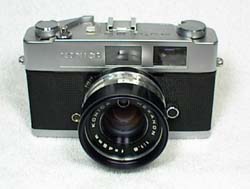
Another nice old rangefinder camera. This particular one was received in somewhat poor condition. It was stored in the never-ready case and there was foam padding in the top and this foam disintegrated into a fine powder that got into everything. The whole camera was covered in a fine powder when I received it. Even the viewfinder has some inside on the glass surfaces and this is very noticeable when inspecting the camera but "disappears" when you use the viewfinder. The rangefinder works perfectly and the frame lines move for parallax correction.
I don't think the foam powder found its way into the mechanicals as the speeds appear to be accurate and the aperture works perfectly. The auto exposure mode is broken but this is not a big problem since it is perfectly usable in manual mode. This is yet another reason I am fond of these old cameras since if the battery dies or the electronics go kaput you still have a functional camera. If the meter was working it would need mercury batteries or one of my homemade adapters. Someday I hope to acquire one where everything works since I really like using this camera.
Not only was the foam shot in the never-ready case but the camera back foam seals were a gooey mess which is typical of cameras this age. They were easily replaced using 2mm Foamies and a little glue. See my camera repair page for a more detailed description of foam replacement.
As I have said before, these old rangefinders take wonderfully sharp pictures and this fast f1.8 lens is no exception. I usually shoot 400 asa in these cameras for offhand street photography but I have only shot Kodak 800 MAX in this one so far.
I decided that I liked to test for flare and sharpness by shooting directly into the lights and at the scoreboard at my daughter's volleyball games, especially since I am there a lot and it is an easily reproduced shot. One of these days I will buy a test target from Edmund Scientific and do a proper lens test.
The following image was shot similar to the one taken with the Bell & Howell Canonet 19.
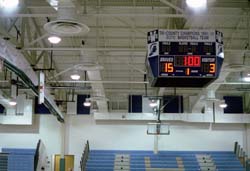 f4 @ 1/60 second, 800asa Kodak
MAX, offhand
f4 @ 1/60 second, 800asa Kodak
MAX, offhand
Next, we have a section cropped from the original 2800dpi scan (converted from TIFF to a moderately compressed jpeg file):
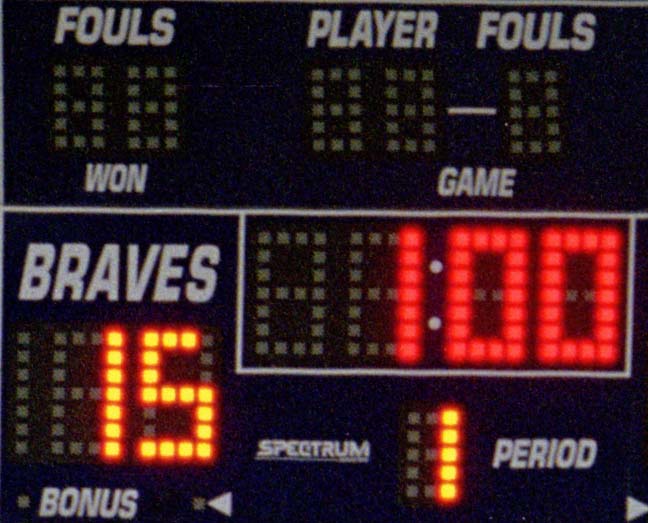
Pretty good on 800asa film and handheld. I did not get the exact same framing as on the Canon so it is a little harder to compare flare except to say that it still looks well controlled with this lens. My subjective observation is that the Konica lens is sharper and has better contrast than the Canon I tested this way. In scanning, I consistently got a better dmax on the film shot in the Konica, whether this is due to a slight difference in the exposure ( I used the same exact exposure in both shots but the cameras may be performing slightly differently) or in the processing or as a direct result of the lens I don't know for sure yet.
Disclaimer: From a purely scientific point of view my methodology may be a little lacking but I think it still produces some usable results. Besides being educational for me (and hopefully others) it is always fun. No matter what, it isn't always about the camera or the lens but about photography, the images you produce and all the pleasure you derive from it.
Check our low prices on long distance and other services for home or business
© 2001
Images on this site are copyrighted and cannot be used without my
written permission.