

Have you met a celebrity who you didn�t like?
�Yeah, that Jay Kay (Jamiroquai frontman) seemed like a bit of a wanker.�
�Yeah, we do have a lot of famous friends, I suppose,� says Stuart Cable, hands on thighs, not much of a frown going on. �When you put it like that.�
You�ve not done that bad for yourselves.
�Yeah, not bad at all.�
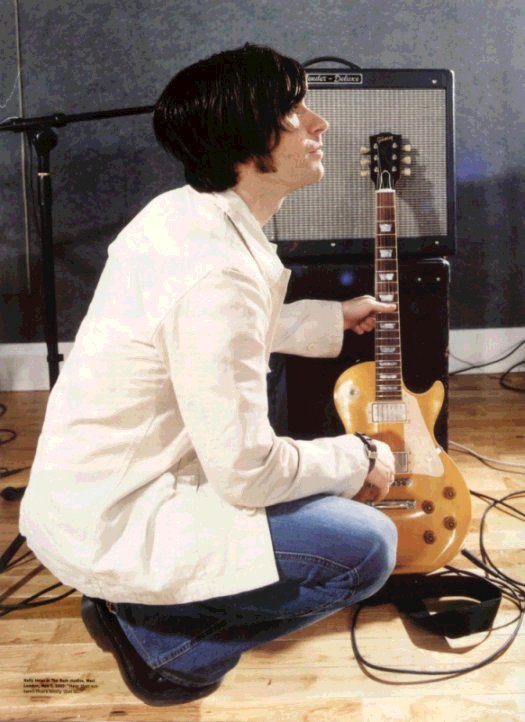
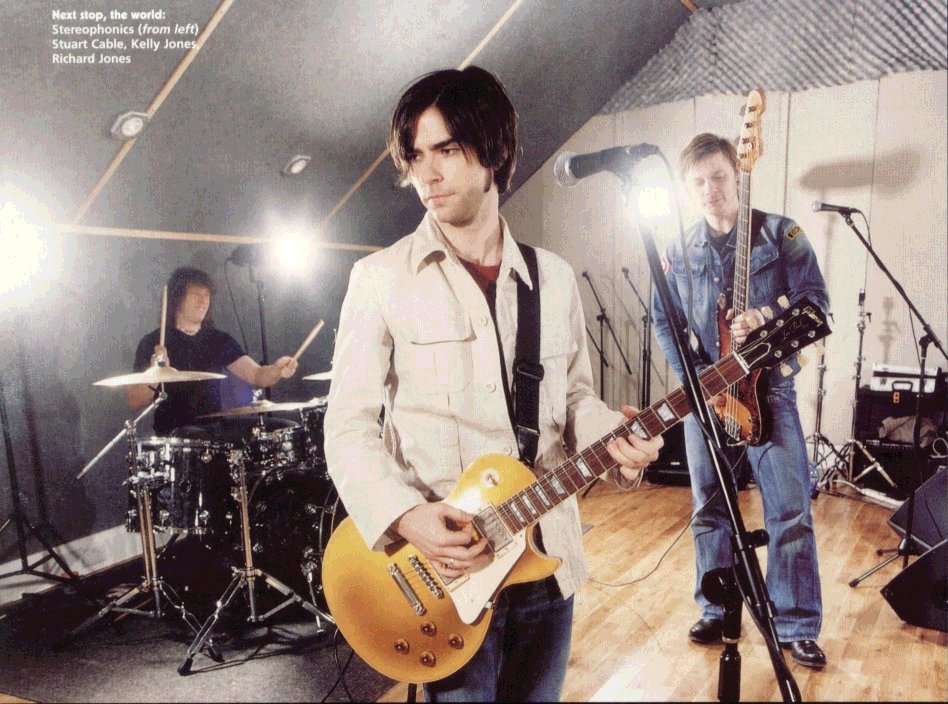
Stuart Cable describes his singer as �short Kelly�, but with some affection. An affection that was presumably absent during the recording of �Just Enough Education To Perform�, where Cable released himself from the recording process, frustrated at the loss of spontaneity in the recording studio. The drummer liked to nail his tracks within three takes, to capture an essence or a spirit of an occasion; the producers would have him play a song six times and still not be ready to record. Goodbye, said Cable. The drummer will admit now that �the band came very close to splitting up at that point. Kelly Jones says that �Stuart was really getting on my tits, and I�m sure that I was getting on his�. But, he says, the situation was resolved quickly, and wasn�t all that serious.
Splitting up sounds reasonably serious. �Well, yeah, looking back on it, it was serious,� he says. �But it was never spoken of, and I never actually thought that we�d split up. But we just weren�t talking about these things. I thought they (both drummer and bassist) weren�t as into as the band as I was, and they thought I was being an arsehole. But now we�ve learned to talk about things. We�ve learned to make it about just the three of us again, and not to worry about other people. We�ve learned to go to the pub together again and watch the football. Things like that. We�ve learned to remember that we were friends before we started this band.�
Kelly Jones was born on the June 3, 1974, in Aberdare hospital, the youngest son of Oscar and Beryl Jones. His father worked in the town�s steel factories, his mother in the local electronics plants. Jones had two older brothers, although he himself is the junior child by almost a decade. His was a happy childhood, one where the streets outside �seemed either to be sunny or covered with six feet of snow�. Opposite the family home was an open-air swimming pool, where Kelly Jones would spend his summers, listened to home recorded Memorex cassettes playing �axe attack� songs by Lynyrd Skynyrd, Rainbow and AC/DC. Oscar Jones would spend his evenings singing in the working men�s clubs of Wales. His son loved accompanying his father on these excursions, loved lifting the speakers in and out of these rooms, watching his father sing, watching how he would deal with the audiences. Later, the Stereophonics would play these clubs themselves, to crowds not in the habit of being either indulgent or forgiving. It was here that Kelly Jones learned what he could and could not get away with in front of a live audience. It was here that Kelly Jones learned not to fuck around.
He got his first guitar at the age of 11, a nylon stringed acoustic that his father ordered from a catalogue for Christmas. He joined his first band at the age of 12, the Zephyr�s, with Richard Jones. After leaving school at 16 he attended film college and studied script writing, editing, animation, all sorts of things. He worked at a fruit and vegetable stall on Aberdare market every Saturday. It�s at this point in the conversation especially that the (very worst) perception of Kelly Jones as a stubborn Luddite begins to come unstuck. He mentions artists such as Jasper Johns; not only this but does so without making a show of mentioning such artists such as Jasper Johns. His songs, he says, were � and, he claims, still are � as much about lyrics as they were about music. They were stories; stories based on the scripts of Quentin Tarantino and Jimmy McGovern (a man with dialogue sharp enough to write a character improvising a limerick to a girl of his affections: �There once was a girl name Emma, who caused a boy�s heart all a tremor, but he�s on a bus, so he can�t cause a fuss, oh my God what a fucking dilemma�) as well as the lyrics of Tom Waits (�A siren tears the night in half�), Leonard Cohen (�Everybody knows you�ve been discreet, but there were so many people you just had to meet, without your clothes, everybody knows�)and Elvis Costello, especially, he says, the 1977 song �Watching The Detectives� (�She pulls their eyes out with a face like a magnet�). Even on the band�s early demo�s, Stereophonics would print a lyric sheet to accompany the music. Concert promoters couldn�t believe this. Songs such as �Local Boy In The Photograph� were born during this period.
Kelly Jones recounts these stories. Not as if they were from a time when he lived in a different world, but simply as if they were from a different time when he lived in a different time. Despite the money, despite the success and fame, this isn�t Shirley Bassey revisiting a past life in Cardiff, or Catherine Zeta Jones recalling times of struggle in Swansea. Kelly Jones owns a house in Wales and a flat in Fulham, but doesn�t seem to have really gone anywhere. Or perhaps that should be, he doesn�t seem to have left behind anything that matters