
NX-1 was an Americanized version of a LM Ericsson (Sweden) Crossbar System. North Electric manufactured this switch starting in the 1956. Nortth Electric called it NX-1 By-Path Crossbar, refering to how the call was setup by the register - marker link.
The first NX-1 (A version) was essentially Ericsson circuits and most of the relay and crossbar switches were manufactured in Sweden. The first NX-1 was installed in Seymour, IN in 1956, I believe the second switch was installed in Winter Park, FL near Orlando. Switch #5 was installed in Live Oak, Fl in 1958.
The system had one or more Line Groups of up to 500 lines in modules of 25 lines. Each module had a crossbar switch providing outlets (SOTs or Subscriber Outgoing Trunks) and incoming call inlets (STT or Subscriber Terminating Trunks). The SOTs connected to Outgoing Registers (REG-O) which accepted the dialed digits and routed the call based on information prewired in the register or obtained from the LG or local number group (Local call) or Translator (Trunk call). Once the register had enought information to proceed, it passed the routing information to the Group Selector Marker which established the connection acrosse the switch to the destination line or trunk.
The Group Selector (GS) originally had two switching stages, which limited the number of routes and total outlets that could be accessed by any one GS. When a switch outgrew the capacity of a group selector, some outlets would be tandemed to another group selector to provide more outlet choices. This "double group selection" was not an efficient method for expanding in larger switch applications so in the early 70's North introduced a new three stage group selector. This selector was available in both two wire (local) and four wire (Toll Center) versions.
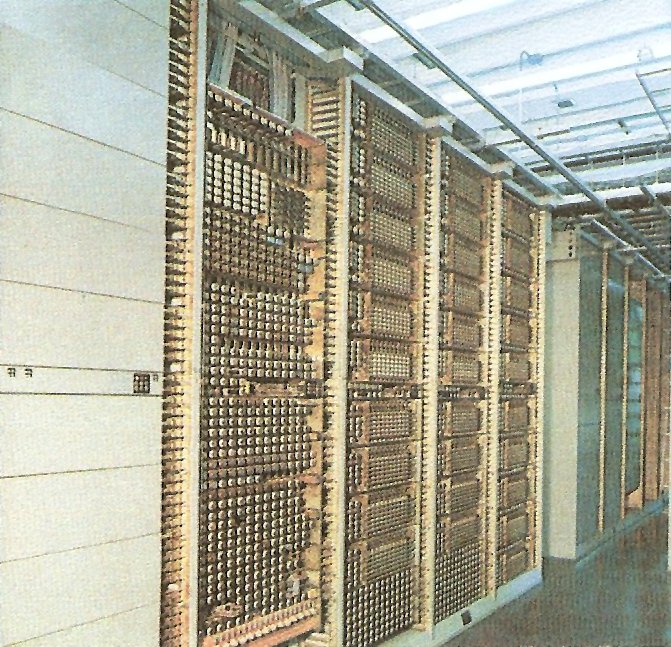
North's first electronic switch, the NX-1E (domestic version) was the same line and group selectors with a computer handling most of the functions of the registers, senders and translators. There were two versions of the "OMNI" processor pairs, OMNI-3 and OMNI-4. The first had a 32K core memory and the latter a 64K! While this was not a true Stored Program Control exchange, it was a big step forward in simplifying translations and digit matipulation beyond what could be done with EM registers & senders. Even so, the call setup and progress was still setup by the GS Marker and the processors did not map or manage the conversation path in their memory, they simply interpreted the digits dialed, translated local and LD calls and passed routing and outbound digits for trunked calls!