(based on a talk given at PhoebusFest 2003)
INTRODUCTION
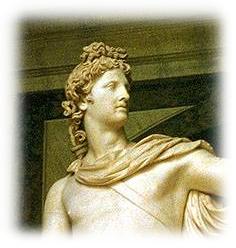
I would like to give you some perspective on Apollo, who is a well-known character in Greek and Roman mythology, and also a Sun-God to Hellenic Pagans. I'd like to talk a bit about the Oracle at Delphi, and some of the Apollonian festivals, as well as the status of Hellenic Paganism today.
APOLLO IN MYTHOLOGY
In Greek mythology, Apollo is the son of Zeus and Leto, and he's the twin brother of the goddess Artemis. Their birthplace was the island of Delos, which was more like a floating raft than an island. Zeus's wife, Hera, was not at all happy that her philandering husband had gotten Leto pregnant, so Hera did everything she could to make life difficult for Leto, mostly by forbidding the Greek people to allow Leto to find a place to give birth. But since Delos was floating, it was exempt from Hera's rule, so it was there that the birth took place. Leto, being a single mom, had some help from the goddess Themis, who helped raise the kids, feeding them ambrosia and nectar to satisfy their sweet tooth. The stories of Apollo's adventures were told by poets such as Homer, Ovid, and Pindar, and although most of them may be fiction, they may also be parables that contain some philosophical truths. There are plenty of stories about Apollo, some of which put him in a favorable light, while others certainly do not.
APOLLO AS SUN GOD
While most of the myths are probably fictitious, Apollo is certainly not a fictitious entity to Hellenic Pagans of ancient times or today. He is a large entity or spiritual force who supports a wide range of interests and activities in life, including music, healing, prophecy, dancing, philosophy, agriculture (especially animal husbandry), the founding of new settlements, the arts, and spirituality. He was known as a protector against plagues and pests in ancient times, and was considered to be the "far-shooter" who used his bow and arrows to destroy such nuisances. Hellenic pagans today can recognize this as part of his healing function, symbolically or literally supporting and boosting the human immune system to help us stay healthy and fight the microscopic invaders that can make us ill. His protection extends to animals as well.
The Greeks and Romans recognized Apollo as a Sun God, which is how he acquired the name Phoebus, which means "radiant". Hellenic Pagans today recognize him as a giver of White Light, whose spiritual functions are very similar to those of Jesus the Christ. These include healing, forgiveness, absolution, and reconciliation, so that each person who comes to Apollo for help can become spiritually whole. In tune with pagan inclusiveness, his healing is not just for the select few, but is open to everyone, and has been since ancient times.
One important component of spiritual and mental health that Apollo stands for is reasonableness. Clarity of thought, rational behavior, and keeping everything in optimal proportion are Apollonian values. He stands behind both the rational and para-rational, but not the irrational.
THE ORACLE AT DELPHI
One of the most famous of Apollo's para-rational activities is the Oracle at Delphi. Since ancient times, this was a very important pilgrimage site in Greece, where people would come from all different places to have a reading done, not only for personal guidance, but before starting any large public project.
The mythology behind it is that the Oracle was originally the exclusive responsibility of Gaia, Mother Earth. But the problem was that her child, the Python, not only guarded the Oracle site, but terrorized the people who lived in the area, doing things that pythons are notorious for -- like maybe eating people's pets and maybe even their children. When Apollo came along, looking for a place to settle and do his work, he first killed the Python, much to the relief of the locals. This story may have symbolic meaning. The world of psychic readings has sometimes been reported to have a negative element to it, which can be a bit scary. But the action of a Sun God like Apollo can clear out all the negative energy and make the Oracle a safe activity, in a safe place.
So, after getting rid of the Python, Apollo took over responsibility for the Oracle. How it worked was that a priestess sat on a tripod and channelled Apollo, while the priests translated what was said into verses or sayings for the person who had come for the reading.
The Delphic Oracle continued to operate until around the year 393 CE, when intolerant Christians invaded, shutting down the oracle, murdering the priests and channellers, and destroying and desecrating the shrines. The shrines, which are sometimes called "treasuries", contained images and and other valuable devotional objects that were placed there by pilgrims who wanted to leave a token of love and gratitude to Apollo. Some of these items are in the museum at Delphi, and others were stolen by the invaders.
APOLLONIAN FESTIVALS
Hellenic Pagans have always had plenty of festivals to celebrate, including the ones that are common to most pagan religions in general, such as the equinoxes and solstices. Festivals that honor Apollo are, first of all, PhoebusFest - Feb. 7, which is celebrated to honor Apollo in his Sun God aspect. He has been identified with Helios at this festival, although Helios and Apollo have sometimes been considered separate deities.
We need to keep in mind that the lunar calendar that the ancient people went by was different from ours, and that there will probably be some variation in the timing of the festivals, as interpreted by pagans and scholars today. But, in general, Apollo's special number was the number 7, and most of his feasts were celebrated on the 7th of the month.
Delphinia is a festival on April 7, which included a procession with olive or laurel branches and cakes that were carried to Apollo's shrine, commemorating the safe return of his son Theseus from Crete. It's a time when people could ask Apollo for protection for safe travelling.
Thargelia is on May 6 and 7, in honor of both Artemis and Apollo, to thank them for their support in cleansing and providing food. For the ancients, it was a lively festival, with lots of good food, music, singing, and optimism, celebrating the people's confidence in the continuing support of Apollo and Artemis in helping provide for their basic needs.
Hekatombaia, celebrated on July 7, was in honor of both Apollo and Zeus.
And on August 7, Metageitnia was a peace festival honoring Apollo for assisting in good relations with neighbors. Although this was considered a minor festival by the ancients, I think it should be a much bigger one.
Boedromia, on September 7, honored Apollo as protector of warriors and those who go into dangerous situations.
Pyanepsia on October 7 honored Apollo and Artemis with a procession where laurel branches decorated with fruit and wool were placed above the door of the temple and over the doors of people's homes, as a thanksgiving and reminder of the good care that the people receive from these deities. The branches would be left there for a whole year, until the next Pyanepsia festival.
A festival honoring the healers Apollo, Artemis, Asklepios and Hygieia, called Small Asklepieia, was normally celebrated on December 7.
HELLENIC PAGANISM TODAY
Hellenic Paganism is considered a dead religion by scholars today, but as long as it's alive for at least one person, it's not dead. In fact, if you look on the Internet, you'll see that it's quite alive and well, although it is far from being a mainstram religion, even among pagans. It is also not really an organized religion, although there are some reconstructionists who are attempting to organize it. Nevertheless, paganism in general is for free spirits, and I don't think it's likely that any centralized structure will form, although there are plenty of groups out there that act as forums for like-minded people. At the moment, it's hard to tell how many Hellenic Pagans there are in the world, and out of those, how many are Apollonian. I suspect that there may be plenty who are either not net-connected or are still afraid to come out of the closet. It's not always easy to have to dodge the two large, hostile groups of people in this society -- one who thinks we're evil, and the other who thinks we're crazy. Most of us are fortunate to have access to the mailing lists that are managed by Kyrene. Be sure to visit her Temple of Apollo.
The Delphic Oracle may have been suppressed in the 4th century and relegated to the status of archaelogical site and tourist attraction, but the spirit of Apollo is still very resilient and alive. Today, there is someone named Adrian who lives in Delphi from April to December, who channels Apollo and does Oracle readings for pilgrims to Delphi and also by e-mail. You can find out more at the Oracle of Delphi website.
Return to Prairie Sun Temple Homepage