2007 South
Coast Paranormal Convention
 To catch a ghost
Paranormal investigators swarm
Santa Paula’s Glen Tavern Inn in search of
headless prostitutes, dead filmmakers and
murdered card sharks
~ By MATTHEW SINGER ~
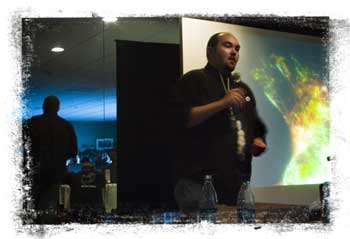 Photo by Lucas Deming
Tom Durant discusses the phenomenon of
’shadow people‘ at the 2007 South Coast
Paranormal Convention.
At the Glen Tavern Inn in Santa Paula, death
is unavoidable. You are reminded of it
everywhere. In the hallways, old movie posters
adorned with the images of long deceased matinee
idols line the walls, a nod to the city’s
filmmaking past. In the early part of the 20th
century, the Citrus Capital of the World was a
major destination for directors and producers, a
sort of sister city to Hollywood. The hotel was
built in 1911 partly to accommodate the stars
and crews who would move in to town for months
at a time. Clark Gable, Charlie Chaplin and Mary
Pickford stayed here. All have since checked out
— of the inn and this mortal coil. One, however,
remains.
That’s the rumor, anyway.
His name is Gaston Méliès, the older, less
famous brother of pioneering French filmmaker
Georges. Méliès was involved, one way or
another, in the production of dozens of motion
pictures beginning in 1903. As a director, he
shot more than 20 films in the area, including a
one-reeler called The Ghost of Sulphur Mountain.
A fan of booze, poker and ladies of the evening,
it is suggested Méliès probably spent a lot of
time at the Glen Tavern Inn, patronizing its
third floor brothel. In 1912, two days before
the sinking of the Titanic, some of his actors
got into a brawl with the innkeeper, sparking a
local tabloid scandal. Méliès returned to France
soon afterward and spent his remaining years
sailing the world with his wife. He died in
1915.
In February, however, Heather Woodward claims
she met Gaston Méliès, right back here at one of
his favorite old haunts. A Ventura native and
self-described “clairvoyant,” Woodward came to
the hotel to investigate alleged paranormal
activity happening in the building since the
late 1980s. Guests and employees have reported a
number of strange occurrences: doors coming
unlocked on their own; detached shadows passing
from room to room; mysterious strangling
sensations in the middle of the night. Just last
year, after ownership of the inn changed hands,
a fire broke out on the first floor. It
originated from rags discovered in a closet, but
according to Woodward, the cause has not yet
been adequately explained.
When she walked into Room 219 for the first
time, Woodward says she was overwhelmed by the
feeling of an otherworldly presence. She
received a “psychic impression” of a man with
light features, an olive complexion and a
mustache, wearing a top hat and a black suit and
smoking a cigar. She also saw visions of ships,
one being the Titanic. Consulting with Richard
Senate, Ventura County’s foremost authority on
haunted places, Woodward learned of Méliès, his
hard partying lifestyle, the fight in 1912 and
his love for sailing. Later, she found a picture
of Méliès online. It looked exactly like the
person she had seen in the room.
It is midnight, July 22, and Woodward is back
in Room 219, along with about 20 other people,
hoping to once again rouse the spirit of the
164-year-old filmmaker. This is the first stop
of an all-night investigation of the Glen Tavern
Inn, the final event of the two-day South Coast
Paranormal Convention, a gathering of ghost
hunters, psychics and other explorers of the
supernatural Woodward helped organize. The room
is laid out like any other modest hotel room:
two nightstands, a wooden dresser, grey silk
curtains, a small television, paintings of
flowers and a bridge. A large, clunky
oscilloscope is set up next to the bed, a pair
of K2 electromagnetic field detectors on top.
The theory is that whenever a spirit passes in
front of the device, the machine can detect its
energy, and its light meter will spike. Thus,
investigators can communicate with a ghost by
asking yes-or-no questions and giving it
instructions: flash once for no, twice for yes.
Around the room is a sampling of those who
paid upward of $125 for a weekend of lectures,
workshops and séances. It’s a multiethnic bunch
of varying ages and genders, some clutching
digital cameras and video recorders. Members of
the Pasadena Paranormal Research Society man the
machines, while a guy named Dave Davee sits in a
corner, scribbling absent-mindedly in a notebook
— “automatic writing,” it’s called. Supposedly,
spirits write through him. The stuff he is
penning now is incomprehensible, but Woodward
swears he can write down what she is going to
say before she says it.
Woodward herself is positioned on the bed,
her sister Sarah reclining next to her. She
tells the audience that, for the benefit of
accuracy, every slight noise has to be accounted
for; if someone coughs or makes the floor creak
or if their stomach growls, the perpetrator must
state their name for the tape recorders, lest
the sound be confused for an EVP, or electronic
voice phenomena. After a debriefing on the
history of the hotel, she decides it’s time to
begin. “Let’s get this show on the road,” she
says.
Lights out. The green glow of the K2s
illuminates the room. Woodward begins asking
questions: Is somebody here? Are you a male? Are
you mad with us being here? No response. Méliès
is apparently a tough interview.
A few minutes of sitting still and quiet in
the dark have the ears of some anxious observers
working overtime. One man insists he is hearing
a faint, repetitive knocking, as if someone were
rapping their knuckles against the dresser.
Others are claiming to hear it, too, but it is
so soft and distant it could literally be
anything. A child’s voice is heard outside the
window. “There are kids out at midnight?”
Woodward asks, in a tone suggesting the source
may not be a flesh-and-blood human. Alas, there
is a quinceañera going on next door, someone
explains.
Suddenly, one of the meters jumps. Contact
with the other side — or the frequency from a
cell phone ringing in another room. Either one
is a possibility. To confirm, Schultz pleads
with the being to do it again. “C’mon. Please.
If you don’t, we’ll think it was something
else.” He is practically begging. Nothing.
Then, the doorknob jiggles. Someone is trying
to get inside. Who is it? Or what is it?
“It’s my wife,” Schultz says, dashing
everyone’s hopes. “She is making her presence
known.”
From skeptic to empath
Rosemary Moffat never used to believe in
ghosts. At 17, she didn’t believe in much of
anything, she says. Then her great Aunt Marjory
died. Days after she passed away, Moffat was
lying in bed, covered by linens previously owned
by her dearly departed relative. There, five
feet away, was Marjory, in living detail; Moffat
can even remember the curlers in her hair. As
quick as she appeared, she faded into thin air.
Moffat smacked herself in the face a few times.
From then on, anything was possible.
“Most people have an experience, and they try
to push it away to the back of their minds,”
says Moffat, now a member of the Real Deal, the
fledgling group of local paranormal researchers
coordinating the conference. “I wanted to pursue
it.”
Moffat’s story is the same as that of the
majority of people at the conference. Few were
born into families of ghost hunters. Most were
skeptics until they saw or heard or felt
something that could not be explained through
earthly logic. Rather than ignore it or pass it
off as the mind playing tricks, they have chosen
to investigate — to prove, possibly, that
they’re not crazy. Of course, to outsiders, a
meeting of metaphysical detectives is crazy in
itself. But spirit hunting is a passionate and
quite serious subculture. Thanks to the
Internet, the individual strands of the
supernatural community have come together to
form a tight-knit society: Many of those
gathered at the Glen Tavern Inn this weekend
know each other from past conferences in other
parts of the country; at least one flew out from
Illinois to be here. And, as the industry has
grown, it has produced its own celebrities,
including the heads of the Atlantic Paranormal
Society, referred to as TAPS, who host the
Sci-Fi Channel’s Ghost Hunters; Chris Fleming,
co-host of the Biography Channel’s Dead Famous,
who will be speaking in Santa Paula on the
fusion of the psychic and the technical; and
Ventura’s own Richard Senate, who will also be
appearing to discuss “house memories” and “retrocognition.”
But the investigation of the Glen Tavern Inn
is the weekend’s true highlight. Although it has
gone through ups and downs over the decades — a
major social scene in the 1920s, it degenerated
into a flophouse post-World War II — the hotel
looks relatively unchanged from when it was
constructed as a companion piece to the train
station across the street. With its wood panel
interior, antique ceiling lamps and ornately
framed mirrors, it seems like the place
turn-of-the-century ghosts would feel
comfortable spending eternity.
Moffat, who now identifies herself as an “empath”
— meaning, she can walk into a building and
absorb its history — says she has yet to pick up
any vibes from the hotel prior to the
investigation.
“But,” she adds, “it looks haunted.”
Room 307
Like Gaston Méliès, Calvin, as he is known to
paranormal researchers, worked in the movie
industry. Also like Méliès, he enjoyed sinful
behavior — gambling especially. A former actor,
Calvin supposedly performed in the popular
traveling variety show Buffalo Bill’s Wild West
in the late 1800s. When the show ended, he went
to Hollywood. He found employment saddling
horses on the sets of silent westerns.
Eventually, he found his way to Santa Paula, and
to the Glen Tavern Inn. According to legend, one
night Calvin was cleaning up at a card game in a
room on the hotel’s third floor, where most
disreputable activity allegedly took place.
Another player accused him of cheating, and in
the ensuing gunfight, Calvin was shot in the
head and killed, his body dumped in a
crawlspace.
In recent years, an apparition described by
Woodward in her book The Ghosts of the Glen
Tavern Inn as “wearing a white shirt, string
tie, long hair and a beard” has been seen in
different parts of the hotel, in the Ladies
Powder Room on the first floor and in the
kitchen, where, during recent remodeling, a
cowboy hat pierced by what appeared to be a
bullet hole was found inside a wall. Mostly, he
has been spotted in and around Room 307 —
perhaps the place where he met his demise.
No substantiating documents have been found
to prove Calvin ever existed. But in the world
of ghost hunting, myth and anecdotes are good
enough for an investigation. And so, just past 1
a.m., Woodward and a group of conference
attendees are again sitting in the dark in Room
307, each brandishing K2s, hoping to pick up on
some spooky energy.
“This is a weird room,” Woodward says. More
than one person is rumored to have been murdered
here. In her book, Woodward writes about a
blonde prostitute who was decapitated for
unknown reasons, her corpse deposited via a
dumbwaiter used to smuggle liquor upstairs
during Prohibition. (Rin Tin Tin also stayed in
307 during the filming of The Night Cry in 1926,
although he apparently survived unscathed.)
Guests have recounted hearing scratching sounds
emanating from the closet and knocking on the
door, as well as seeing impressions on the bed
spread.
Unfortunately, the only sound heard here this
evening is the hum of the mini-fridge. The
lights on the K2s do leap at odd moments, but
the spikes seem too erratic to be conclusive.
At one point, though, one of the women in the
room complains about a creeping sense of unease
— like someone is staring over her shoulder. Her
name is Maricela Diaz. She came to the
conference at the behest of her brother, but she
is no stranger to the paranormal; once, she had
her house in Lompoc exorcised to remove a
hostile spirit. She didn’t want to come here,
because she knew something like this would
happen. She says her hands are getting clammy.
Another woman snaps three photos of her. The
last two are clear, but the first is blurry. It
looks as if Diaz is bathed in white mist.
“You know what I saw behind you?” Woodward
announces. “A noose.”
Woodward instructs Diaz to tell the ghost —
or whatever it is — to give her “personal
space.” She does, but the feeling does not
alleviate. She moves to another part of the
room. She says it feels like her hands are being
pulled back toward the closet. The discomfort is
too much; she has to leave the room.
The rest of the group remains in 307 for a
few more minutes. No one else is similarly
possessed. Sensing the crowd is a bit freaked by
the experience, Woodward decides to move on. She
thanks the spirit for its attempt at contact,
and corrals everyone out of the room.
They are not alone
It is now 2 a.m., and the lobby of the Glen
Tavern Inn is filled with weary ghost hunters.
Although the investigation was scheduled to go
“all night,” it appears the two days worth of
séances, demonology workshops, movie screenings
and lectures on shadow people and telepathy has
burned the group out early. Some are comparing
notes, scanning their digital voice recorders
for EVPs. Others are nodding off, breaking for
their rooms or discussing plans to find a gas
station that sells microwave burritos.
There does not appear to have been any
groundbreaking, earth-shattering,
vortex-of-the-universe-opening discoveries made.
And that is fine. No one is presumptuous enough
to expect to uncover such things in the course
of a single weekend; most acknowledge they never
will. But the underlying point of this
conference is not necessarily to produce
indisputable evidence of life after death: It is
about the exploration, and the community of
individuals willing to delve into the unknown.
Perhaps there is nothing out there beyond what
the eye can see, but in the physical world, they
know, for a fact, that they are not alone.
07-26-2007
