Saturday November 16, 1957
Saturday November 16, 1957
Jury Finds O'Kasick Guilty of Second Degree Murder
Verdict
Stipulates
Life Term
By PEG JOHNSON
Minneapolis Tribune
Staff Writer
James Michael O'Kasick, 20, Friday was found guilty of second degree murder in the Aug. 17 slaying of Patrolman Robert Fossum.
The conviction carries a mandatory sentence of life imprisonment. O'Kasick will be eligible for parole after 17 years with good conduct.
THE JURY of 10 women and two men began deliberating at 2:15 p.m. yesterday. The jurors returned to the courtroom at 4:45 p.m. for clarification of the differences between first, second and third degree murder.
Twenty minutes later they announced they had reached a verdict. The jury foreman, Robert A. Dusel, 2424 Stevens Avenue, delivered it at 5:20 p.m.
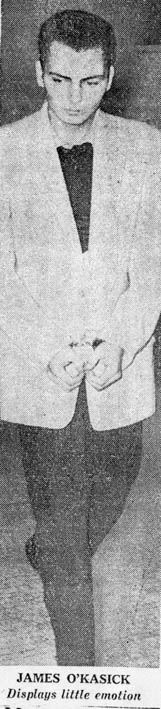
The slender, 5-foot, 5 1/2 inch defendant showed no change of expression as he heard the verdict read.
He kept his eyes downcast and chewed the inside of his mouth as he had d o n e throughout the four-day trial.
NO DATE was set for sentencing O'Kasick, pending action on two other indictments against him for kidnapping a Bloomington woman during the brothers' flight following the shooting, and for first degree assault on Fossum's partner, Patrolman Ward Canfield.
George M. Scott, Hennepin county attorney who prosecuted O'Kasick, said the assault charge will be held in abeyance until it is certain that Canfield will not die from his injuries. .
If he does, a murder charge would replace the assault indictment, the county attorney said.
Scott suggested it is up to O'Kasick and his attorneys whether the youth will plead guilty to the kidnapping count.
OTHER CHARGES may face O'Kasick in Anoka County, where the three O'Kasick brothers were apprehended.
Robert Johnson, Anoka county attorney, said a hold order has been placed against James, and the county grand jury will consider charges at its new term Nov. 26.
O'Kasick's trial this week was on an indictment for first degree murder.
However, his attorney, Lewis E. (Scoop) Lohmann. public defender, asked the jury to convict the youth of third degree murder instead, on the grounds there was no intent to kill Fossum.
Such a conviction carries a prison of 7 to 30 years. In addition, James could have been remanded to the custody of the youth conservation commission, which can parole at its discretion.
Only difference the penalty for first and second degree murder, according: to Scott, is that the state pardon and parole boards tend to give greater consideration to persons convicted of second degree.
FIRST DEGREE murder District Judge Rolf Fosseen instructed the jury, involves a premeditated intent to kill. Second degree involves a design to kill, but not deliberation or premeditation. Third degree murder is unintentional killing while in the commission of a felony.
If James O'Kasick aided and abetted his brothers, Roger and Ronald in killing Fossum, Fosseen told the jury, he is as guilty of the crime as if he had fired the shot.
O'Kasick admitted he shot Canfield, who is still in critical condition at General hospital, but he said his brother, Roger, killed Fossum.
Roger and Ronald were killed by police fire when the O'Kasicks were apprehended Sept. 14 on Carlos Avery game farm in Anoka county. James turned a gun on himself but survived.
VETERAN courthouse observers said the trial probably was the shortest murder trial on record in the county.
The jury was chosen in less than a day, the state presented its witnesses in a day and a half, and O'Kasick was the only witness in his own defense.
The O'Kasick brothers killed Fossum and wounded Canfield in a gun battle at W. Thirty-ninth Street and Blaisdell Avenue after the officers pursued the brothers stolen car. The trio was en route to rob a Red Owl store at the time and were armed heavily.
IT WAS the first killing of a policeman on duty in Minneapolis in 24 years, and the 29th such crime in the city�s history.
Lohmann, in his final argument to the jury, characterized James as "not basically bad," reared in "miserable surroundings, in a large family, with his father in prison and his mother dying when he was only 15."
"He was dominated by the older brothers he idolized," Lohmann said, "and raised in an environment that breeds this sort of thing.
This crime was tragic and unfortunate and these desperate boys were wrong," he said, "but there is no evidence that any one of these boys had any intent to kill.
"Jim is as remorseful as man can be," he concluded. "I ask that you (the jury) do I what is right."
Scott said the shooting was done by a "cool and calculating gang" and said if James didn't intend any harm he could have run away at any time during the fray.
"IT SEEMS to have been a special O'Kasick law to go out and rob when they needed money instead of going out to work in the morning.
"By what right does a gang become a law unto itself?"