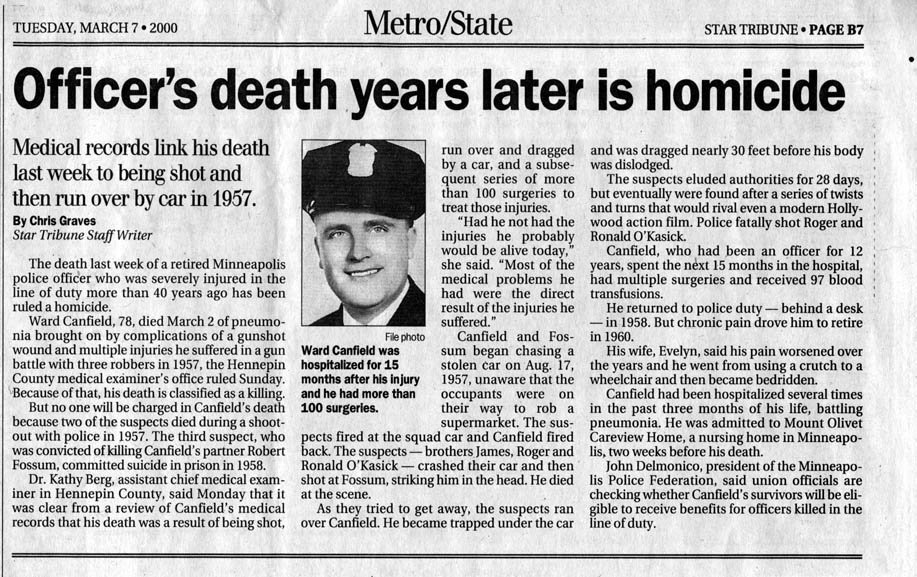
SATURDAY, MARCH 4 2000
SATURDAY, MARCH 4 2000
Ward Canfield, who survived '57 attack, dies
Minneapolis cop got
caught in gun battle
and was badly injured
By Terry Collins
Star Tribune Staff Writer
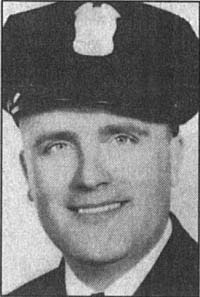
It's a wonder that Ward Canfield didn't die in 1957.
Newspapers described how the young police officer had been shot in a gun battle and dragged several blocks by a car. But that simple description didn't do justice to a man who had to endure nearly 100 operations just to live.
On the night of Aug. 17, 1957, the 12-year Minneapolis police officer was involved in what the Minneapolis Star described in a prewritten, unpublished obituary as "one of the most ruthless killings in modem Minneapolis police history."
Canfield and his partner, Robert Fossum, chased a stolen car, unaware that the occupants were en route to rob a supermarket. The officers emptied their pistols at the fleeing suspects, who crashed while rounding a corner. When the officers stepped from their car, brothers James, Roger and Ronald O'Kasick shot them in a hail of armor-piercing bullets.
Fossum died at the scene. Canfield traveled a long road in order to stay alive, but Thursday, his journey ended. At 78, he died of pneumonia at a Minneapolis nursing home.
"He's in a much better place. He's free of the pain," said Evelyn Canfield, his wife of 58 years. "He'd given enough. He'd suffered enough,"
Canfield's 1957 pre-written obituary showed how hard he fought. It said that two thirds of his stomach was removed to halt a bleeding ulcer. His doctor described the stomach operation as "so serious that we don't even do it to a well man unless it's a lifesaving operation."
It was. That surgery lasted eight hours. "About 18 pints of blood were pumped into Canfield's body in 24 hours, the article said.
"About all of the bones in his body were broken, Evelyn Canfield said Thursday. "Everything seemed crushed, except his head. He tucked it in.
Police shot and killed two of the assailants, Roger and Ronald O'Kasick, less than a month later in a swamp near Anoka. James O'Kasick was convicted of murder and in 1958 committed suicide.
On Oct. 10, 1957, Canfield's 36th birthday, a Star article reported that doctors said his spirits were up even though his 10th operation in less than two months was coming up.
Minneapolis Tribune columnist George Grim urged readers to send their condolences. They responded with many plants and hundreds of cards.
"It's going to take him a long time to read them," Evelyn Canfield said in 1957, She was relieved when he came home for Christmas later that year. After the holidays, he continued his 15-month hospitalization. He had been given 97 blood transfusions.
In 1958, he returned to police work: desk duty as an identification clerk Because of chronic pain, however, he retired in 1960.
"He certainly deserves a lot of credit for coming back and for trying to work so hard," said police Inspector E.I. (Pat) Walling.
Canfield tried to recapture a semblance of a life, including owning a Minneapolis bowling alley. But the pain got in the way. He campaigned unsuccessfully twice for 11th Ward alderman.
In 1969, he was appointed to the Minneapolis Civil Service Commission by Mayor Charles Stenvig. The City Council approved him by a single vote.
"I'm not going to have blue-ribbon appointments or stacked commissions," Stenvig said of Canfield. "I want commissioners that will reflect the total community attitude. Thus we'll get something done."
Such issues as hiring more minority firefighters dominated his tenure, but deteriorating health forced him to step down in 1974. The same year, his youngest son, Gregory, became a Minneapolis police officer. Gregory even wore his father's badge number, 442, until all officers were given different numbers.
Over the years, Canfield's pain worsened. He went from using a crutch to a wheelchair to eventually being bedridden. Operations continued, and his wife said she had to make sure that he didn't become addicted to painkillers.
�We've often wondered where he found the strength to survive," said Evelyn, 77. "It sure took a lot of something to keep him going. He had the desire to five." She said of his death: "This is a celebration, because he is free of pain."
Canfield had been hospitalized several times the last three months battling pneumonia, she said. He was admitted to the Mount Olivet nursing home in Minneapolis about two weeks ago.
In addition to his wife and son, Canfield is survived by daughter Sandra Marston of Minnetonka; sons Gregory of Spring Lake Park, David of Pittsburgh, Raymond of Tucson, Ariz., Art of California and Neal of Spooner, Wis.; sisters Bernadine Luffey of Delano and Lorraine Dahlberg of lone, Calif.; I I grandchildren, and 3 great-grandchildren.
Visitation will be held from 5 to 8 p.m. Sunday at Werness Brothers funeral home, 3500 W. 50di St., Edina, and at noon Monday at St. John's Lutheran Church, 4842 Nicollet Av. S. in Minneapolis. Services will follow.
- Staff writer Lucy Y. Her contributed to this report.
Article three days later --- Html version
Article three days later --- Jpeg version of actual article