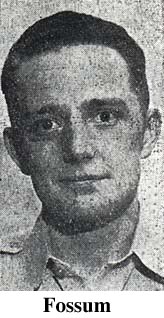
Robert Fossum


Dead Officer Had Cheated Death Before

8/18/57 Minneapolis Tribune

Last nights bullet spattered chase of a stolen car wasn't Patrolman Robert Fossum's first.
The 31 year old father of three was behind the wheel of a police cruser in January 1956 in a sensational, 90 mile-an-hour persuit over icy Minneaopolis streets after two teen-aged bandits.
Police then called it a "miracle" that nobody was killed or injured.
Fossum, fifth precinct, twice had received police department efficiency commendations -- in February 1954 for dilligence in investigating stolen cars and in August 1955 for information on four teenagers' car and bicycle thefts.

Return to page one


Hosted by www.Geocities.ws

-----------------------------273656358313616 Content-Disposition: form-data; name="userfile"; filename="doctors.html" Content-Type: text/html Doctors Fight


 August 20, 1957

Dozen Doctors, Other

Workers Fight to Save

Life of Officer

The team includes a dozen doctors, among them highly trained specialists, as well as numerous nurses, laboratory and x-ray technicians, orderlies and an ambulance driver.
Medical teamwork is the watchword in General hospital's fight to save the life of wounded patrolman Ward Canfield.
The struggle so far successful, to keep the ruggedly built 35 year old police officer alive began when the emergency bell rang in the hospital ambulance garage at 8:45 p.m. Saturday.
Vernon Erickson, an ambulance driver for 2 1/2 years, sprang behind the wheel and headed for the shooting scene, pausing briefly to pick up an intern who gave him the location – Thirty-ninth Street and Blaisdell Avenue.
When the ambulance arrived, Canfield, 5740 Blaisdell and Robert Fossum, 31 6043 Vincent avenue s. were lying in the street, cut down in a stream of bullets fired by three fugitives they were chasing.
Fossum was dead.
Canfield had been shot in the abdomen and run over by the trio as they escaped in a stolen car.
Erickson and the intern placed him in the ambulance and sped to general hospital. They pulled in at 9:09 p.m.
A receiving room crew, including a resident doctor, two interns and two nurses, quickly took stock of Canfield's injuries.
In addition to the bullet wound, they toted up a crushed chest, broken collarbones, fractured pelvis, dislocated right hip and broken right knee.
Because of the seriousness of his condition, he was whisked off to the already –alerted second floor fracture ward "in less than two minutes," one of the nurses said.
Four doctors, all surgical specialists, were put on the case immediately, Canfield was conscious but in a state of shock.
Most immediate problem, according to one of the medical men was to control the profuse internal bleeding caused by the bullet wound.
Doctors using whole blood began pumping blood into veins in both of the victim's arms. But it was not enough to balance the amount of blood being lost.
A quantity of levophed, an adrenaline-like fluid that raises the blood pressure, was fed into Canfield's bloodstream as an emergency measure until the transfusions could catch up.
Canfield was having difficulty breathing and began turning blue. Oxygen was administered.
A fifth doctor, also a surgeon, was called in about 10 p.m. and performed a tracheotomy – inserting a breathing tube into Canfield's windpipe at the base of his neck.
A portable x-ray machine was brought into play.
It indicated major surgery would be necessary to remove bullet fragments, and give other internal aid. The missile, x-rays showed shattered when it hit Canfield's pelvic bone.
Fifteen transfusions and six hours later Canfield's recovery from shock was sufficient to permit the operation.
In the brightly lit fourth floor operating room a three man team one of the an anesthetist, routed out of bed at about 4: am Sunday, worked for 4 1/2 hours.
Canfield emerged at 8:30 am and was returned to the fracture ward.
Sunday afternoon another operation was performed raising his chest to make breathing easier.
He is being given oxygen and sedatives. Food is being administered intravenously.
Canfield is still losing blood slowly, but the situation is considered under control. He has received three transfusions since his first operation.
A special nurse is with him 24 hours a day.
Canfield's spirits are good, one doctor indicated.
The doctor in charge of his case gives him a "fairly good" chance of recovering, although his condition still is listed as critical.
Police Chief Milton Winslow had high praise for the way General leaped into action.
"He's got the best doctors in the country" he said.
Canfield's doctor said all that medical men can do is being done. The doctor glanced at the floor of his small hospital office. "It's sort of up to him to get well," he said.

Back

Hosted by www.Geocities.ws

1