| With the winds and seas finally starting to subside Sunday evening, we began to drive KUHELA toward this goal. Our intention was to not let the boat speed drop below 5.5 knots in order to make the Yucatan Channel in time. On Monday, with seas 2-4 feet and with wind fluctuating between 7 to 15 knots, mostly from the NNE, we either sailed or motorsailed. Only for a few hours Monday evening as we approached the channel did the seas become choppy and uncomfortable. Otherwise we had calm seas and almost no wind in the Yucatan Channel. About 2 a.m. Tuesday we rounded Cabo San Antonio off the western end of Cuba and headed NNW for 16 miles until passing the nearby reef. Now we were officially in the Gulf of Mexico and out of the Caribbean Sea. Once pass the reef we set a course for the Dry Tortugas. The plan was to sail by the Dry Tortugas before heading north in order to gain easting in case the weather changed. Also, there were fewer crosscurrents along this route. We had little wind, flat seas, and no swell our first day in the Gulf. We motored until 10 p.m. Tuesday when the winds finally came up from the ESE. At 3 a.m. Wednesday we passed north of the Tropic of Cancer and were no longer in the tropics. Wednesday we sailed with 15-18 knot winds, first from the SE, then ESE, and last E. All day we kept an eye on the weather as a cold front, the first northerner of the season for Florida, was moving down into the Gulf of Mexico and Florida sometime Friday, or possibly even earlier. Winds were expected N 25 knots and seas 11-13 feet. The temperature was to drop to 40 degrees. After passing the Dry Tortugas at 6 p.m., we decided to alter course slightly and sail more toward Fort Myers during the night just in case the storm arrived early or the winds shifted to the north. Once we received the favorable outlook from the weather report early Thursday (Thanksgiving Day) we changed our track back to St. Pete Beach, now only 124 nautical miles away. The storm wasn�t expected in the Tampa area until 6 p.m. Friday. Our last full day at sea started out with winds E 20 knots and ended with almost no wind. In the morning we definitely felt the �G�s� as we moved fast through the water, intent on getting home before the cold front arrived. Around noon, with lighter winds, we were having the �dream� sail. With nightfall we could see the illumination off the Florida coastline. At 4 a.m. Friday, November 28, KUHELA arrived at the sea buoy off the Pass-a-Grille channel, and two hours later she was tied up at her boat slip, glad to be home. In all, we sailed 1400 nautical miles in 10 days and 18 hours, sailing almost the entire distance on the starboard tack. We did a lot of windward work, and so passed a lot of water over the decks. Before this passage we visualized mostly favorable currents, especially from the Gulf Stream. Instead, we ended up having more counter currents, especially on the leg from New Bank to Cabo San Antonio, Cuba. We encountered more ship traffic this passage, especially near the Yucatan Channel. Last, we were extremely �lucky� with the weather, both in the Yucatan Channel and along the Florida coastline. A delay of just 12 hours in either place could have made quite a difference. Our plan now is to enjoy our condo in St. Pete Beach until May when we push off for the Mediterranean. |
| Page 2 |
 |
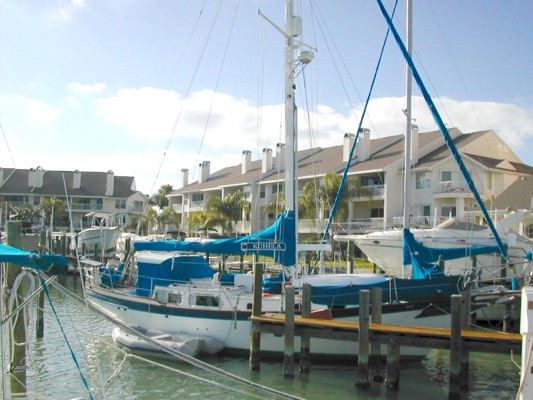 |
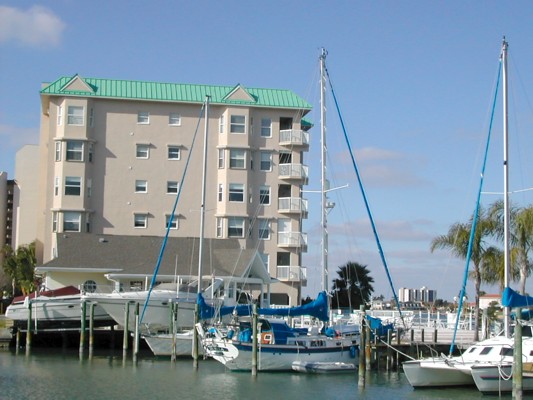
| Kuhela Moored at "Home Port" Captiva Cay, St. Pete Beach, Florida |