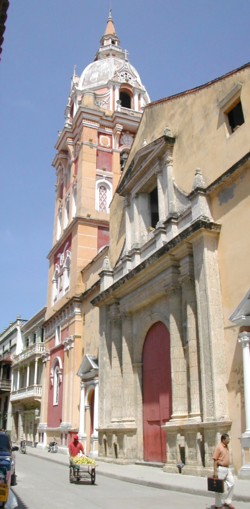
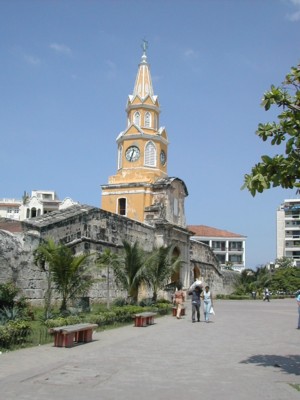
| One of our highlights during our stay was our evening attending the Colombian Folclorico Dancers of Sincelejo at the beautiful Heredia Theater. The history of Colombia was presented through dance numbers from pre-Hispanic to present day showing the progression throughout the years of the three ethnic groups comprising Colombia: the Indians, the Spanish, and the Blacks. Cartagena today is a mixture of these groups. Afterwards seven of us cruisers enjoyed a lovely late night meal sitting outside in the beautiful San Pedro Claver Plaza amongst all the lit towers. While in Cartagena, local elections were held the weekend of October 25 and 26. For the day prior to the election and the two days of the election no alcohol could be served in restaurants and bars. Also, Halloween, an American influence, was observed. To be in Cartagena during the Independence Day Celebrations was definitely interesting. As this was their only big festive celebration of the year, it was almost a carnival atmosphere. The actual date of Colombia�s independence from Spain was November 11, 1811. Cartagena�s festivities started much earlier as it was host each year to the Miss Colombia Beauty Pageant, and because of this dual role many of Cartagena�s independence festivities intertwined with that of the beauty pageant. The twenty-two beauty contestants from each of the different states in Colombia arrived November 1 and the crowning of Miss Colombia took place November 17. The festivities peaked from November 11 to November 17 when almost the entire city was on holiday. Fireworks could often be heard throughout this period. |
 |
 |
| We attended the main �national� parade on November 13 that displayed the beauty contestants and dancers from each of their particular states. The short parade route was thick with people, almost 300,000. Unless one was near the front, one had almost no chance of actually viewing the parade and so many resorted to a �different� type of fun. Luckily we were up in the stands, and observing the mass of humanity below was entertainment in itself. We had heard about the different parade traditions that had grown over the years, but one needed to see it to believe it. And, one definitely needed to be in a particular party atmosphere to enjoy. We were told not to wear good clothes. Basically flour was thrown at times, drinking water from small plastic bags was squirted, and people brought paint made from carpenter�s chalk and water to try to paint each other, naturally all in fun. As local beer and rum companies sponsored the parade, beer and rum were easily purchased during the parade. When one tried to cross the bridges to enter the �old� city, boys painted in black (representing the slave era) blocked one�s path asking for money. If one said he had no money or gave them a coin instead, one passed unpainted. |
 |
| Page 4 |