The Islamic holy month of Ramadan, called Ramazan in Turkey, was taking place during our trip. In Cappadocia, even though only about 5 to 10% of Muslims still prayed five times a day, almost everyone fasted during Ramazan from sunrise to sunset. At sunset, cannon fire would announce the start of feasting. We had heard this sound back in Marmaris. However, it wasn�t until Goreme that we heard for the first time the Ramadan drummer, a tradition dating back to the age before alarm clocks. As our room faced the street, every day around 3:30 am we would be awakened briefly by the rat-a-tat-tat of the drummer as he traveled the streets, letting those know who wished to eat before sunrise that they needed to arise.
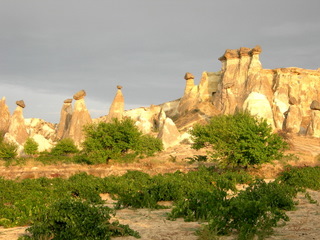
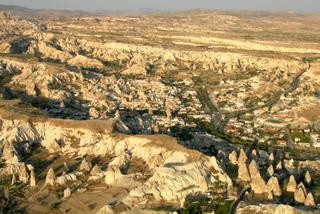
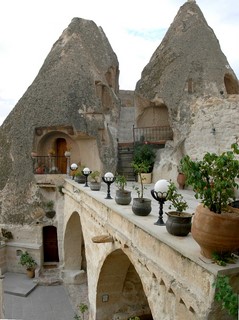
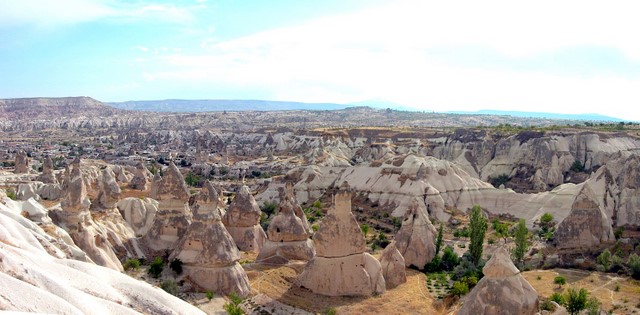
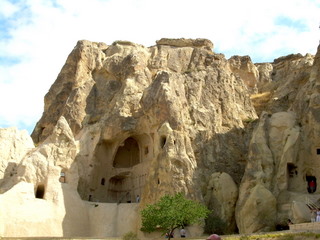
Our first day in Cappadocia we hired a guide, named Mustafa, to show us around the Goreme Open-Air Museum, the Underground City of Kaymakli, and the Haci Bektas Museum. In Goreme Valley, where Goreme village was located, early Christians had built a cluster of Byzantine churches, chapels, and monasteries, over 30 in all, mostly dating from the 9th century onwards. Known as the Goreme Open-Air Museum, this area now was a World Heritage Site. At one time, the interiors of many of these churches had been completely covered with Byzantine paintings depicting stories from the Bible, primarily the life of Christ, as paintings were an important teaching aid in early Christianity. Now, in most of the rock-cut churches only portions of the paintings existed, but in Karanlik Kilise, built at the end of the 12th century, these exquisite Byzantine paintings with their vivid colors had been well-preserved due to the lack of light inside. Seeing the inside of this church was undeniably awe-inspiring. |