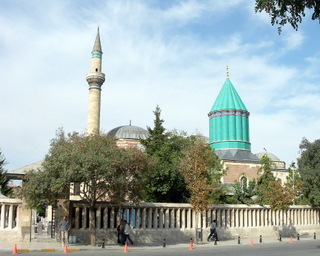
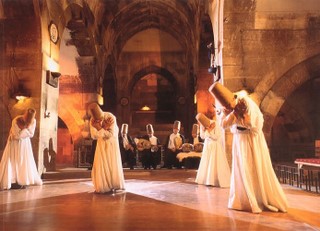
| Konya stood out in the middle of the barren landscape, almost like a caravan oasis of days gone by except that it now was a huge, sprawling city of 800,000 people. The city had been inhabited since Hittite times, but it was at its peak during the 13th century when it was the capital of Seljuk Sultanate of Rum. In Konya, we visited the Mevlana Museum. Celaleddin Rumi, one of Islam�s greatest mystic philosophers, had lived in Seljuk-ruled Konya during the 13th century. Rumi, also called Mevlana, founded the Mevlevi dervish sect, known today to tourists as the Whirling Dervishes due to their sema (ceremony) ritual involving whirling climaxes. During the Ottoman era, dervish orders had become influential. Ataturk, considering them a threat to his idea of a secular state, banned all dervish orders in 1925. At the Mevlana Museum we visited Mevlana�s tomb, a shrine for Muslims, plus toured parts of the former lodge where the dervishes (monks) had lived. Most interesting were the dervish paraphernalia. |
 |
 |
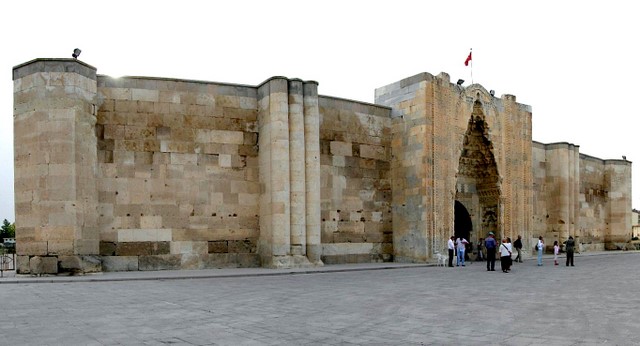
| Along our drive from Konya to Cappadocia we saw wheat, sugar beets, potatoes, and squash being harvested and taken to market. Mostly Kurds from southeast Turkey had come to work the fields, and their tents could be seen periodically alongside the road. During our drive we passed a sugar processing plant where rows of trucks, all full of sugar beets, were waiting to be unloaded. This highway was also part of the Roman-Byzantine road system known as the Silk Road, and it was on this road that Marco Polo traveled in the 13th century. During Seljuk times, many hans (storage depots) and caravanserais (inns) were built along this route, and every so often we spotted the ruins of one. Halfway between Konya and Goreme (where our pension was located in Cappadocia) we visited one of the best preserved Seljuk caravanserais, Sultanhani. It was built in 1229 and recently restored. It had been well-fortified, and its one entrance displayed the Seljuk ornamental exterior portal design of the 13th century. Inside was a courtyard with a small raised prayer room in the center. On the left side were accommodations for the travelers and on the right a covered area to provide shelter from the hot sun. At the back was a storage hall where goods could be safely stored by the caravans. We walked inside this hall and were astonished by its huge size. After visiting Sultanhani we continued on to Cappadocia, arriving at our pension just after dark. |
 |
| Page 2 |