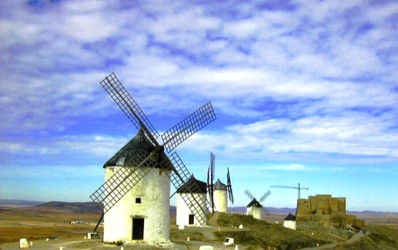
| Monday we drove from Granada to Toledo. When we left Granada it was raining, and as we drove across the pass to Jaen, we encountered snow. Thankfully once in Jaen, the weather started to clear. Like on our drive to Granada from Sevilla, all the hills during the first part of our drive were covered with olive trees. As we drove out of the Andalucia region in the southern part of Spain and into the Castilla-La Mancha region, the terrain slowly changed. Now we were in Don Quixote country. We stopped briefly on the hillside just outside Consuegra, feeling the cold wind on our faces as we looked out over the landscape. Located on the hill with us were the ruins of a 12th century castle and 250 year old windmills once used to grind grain. |
 |
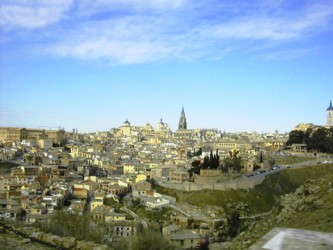
| Toledo was impressive. This entire charming medieval city, located on a strategic hilltop, protected on three sides by the Tajo River and surrounded by ancient walls and gates, was now a world heritage site. Because of its strategic location, this city had been important throughout history: first to the Romans, then to the Visigoths, next to the Moors, and last to the Christians. Also, it was known as the city of three cultures: Christian, Moslem, and Jewish. For centuries, up until the time of the Inquisition, these cultures had coexisted peacefully, adding to the intellectual and artistic greatness of the city. Up until 1561, Toledo was both Spain�s political and religious center. At that time, the political capital was moved to Madrid, but the religious center for the Catholic church continued to remain in Toledo. |
 |
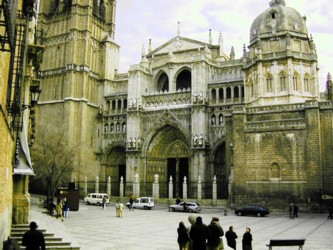
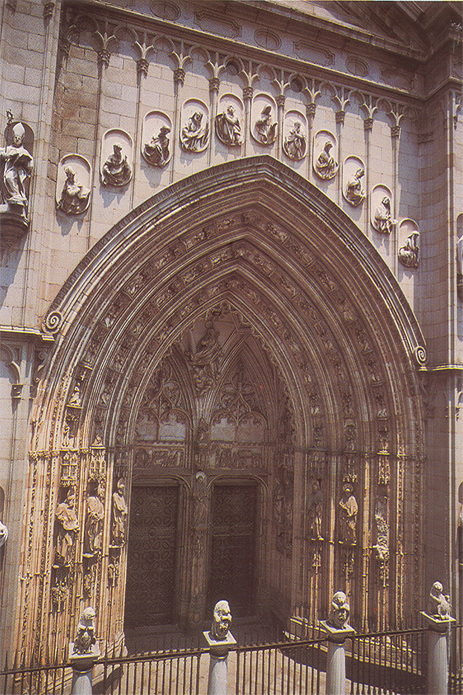
| Late Monday afternoon we visited Toledo�s cathedral. Its interior was breathtaking, truly one of the most beautiful cathedrals. Once inside, all we could say was �wow.� It was so impressive. Afterwards we �tried� to stroll along some of Toledo�s narrow labyrinthine streets, but it was just too cold, especially due to the wind chill. |
 |
 |
| Page 6 |