June 14, 2005
We finally pushed off from Lagos, Portugal, on Saturday afternoon, April 16. We never dreamt when we departed Lagos that it would take us almost two months to reach the Balearic Islands.
We day-hopped down along the coast to Cadiz, Spain, making terrific time. We sailed either on a broad reach or beam reach with winds NW or W 20-25 knots, with gusts a few times to 30 knots. Our first night we anchored in Portimao, 8 nautical miles east of Lagos. The next day we sailed 40 nautical miles to the Faro/Olhao tidal lagoons, anchoring for the evening off of Isla Culatra. Monday we traveled 50 nautical miles to Huelva/Mazagon, Spain, anchoring near where Columbus set out on his first voyage to the New World. That evening with our arrival in Spain, we moved our clocks ahead one hour. Tuesday, April 19, we traveled the last 40 nautical miles to Cadiz, taking a berth at Puerto America Marina just outside the historic town.
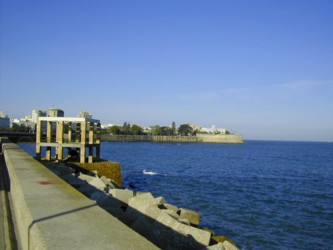
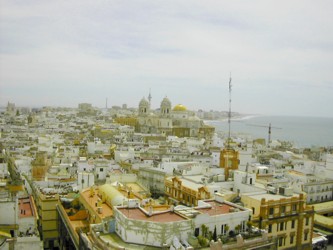
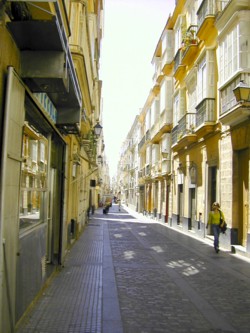
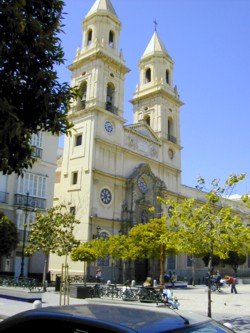
The old town of Cadiz, situated at the tip of the narrow peninsula, was considered to be one of Spain�s oldest towns. Because of its strategic maritime location, it was highly coveted by early seafaring civilizations: first the Phoenicians, then the Carthaginians, and last the Romans. During the 17th and 18th centuries, most of the treasures from the New World arrived in Cadiz, especially after the Customs House was moved from Seville to Cadiz in 1717. During this period as Spain�s principal trade port, Cadiz flourished into a beautiful 18th century Spanish town with lovely architecture, narrow streets, and many plazas. As we had sailed almost the same exact route in our boat as that taken by Spain�s Fleet of Galleons returning from the New World with their treasures in the 17th and 18th centuries, we were excited to be in Cadiz. |