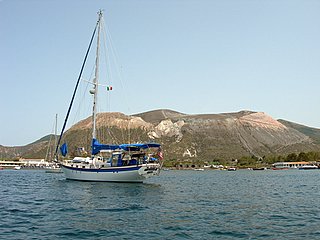
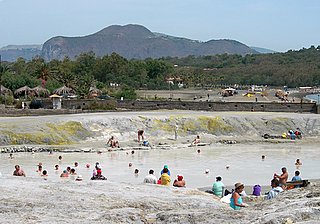
| Early Thursday morning we departed Cefalu for the Aeolian Islands (also known as the Lipari Islands) about 35 miles off the northeastern coast of Sicily. We planned our first anchorage in this archipelago to be at Vulcano Island, a distance of 49 nautical miles from Cefalu. During our stay we anchored in front of Gran Cratere, the only active crater on the island, and in the evening we often received whiffs from its sulfurous fumes. Gran Cratere on Vulcano Island was one of five active volcanoes in Italy. The others were Stromboli, also in the Aeolian Islands, and Mt. Vesuvius in southern Italy and Mt. Etna in Sicily. Vulcano Island was specially known for its therapeutic mud baths. |
 |
 |
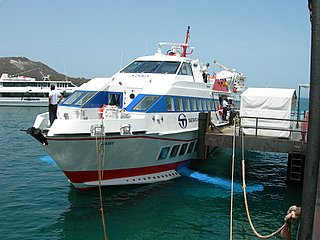
| Saturday we took the hydrofoil from Vulcano Island to Lipari Island to visit the Aeolian Archeological Museum located inside the citadel above the town. This museum displayed an amazing collection of miniature Greek tragedy and comedy masks buried with the dead around the 3rd century BC. |
 |
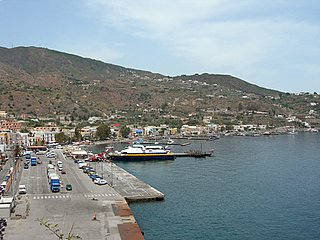 |
| Li[ari Waterfront |
| We had originally planned to visit Stromboli Island before heading south toward the Strait of Messina. Instead, we headed immediately for the large city of Siracusa (Syracuse) on Sicily�s southeastern coastline as we felt Mary�s knee might need to be seen by an orthopedic doctor. We departed Vulcano Island early Sunday morning, June 18. With no wind, we motored south.
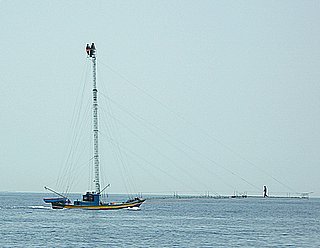
Approaching the Strait of Messina we saw for the first time the swordfish boats designed to catch the migrating swordfish in the strait. We were entertained as this boat moved around trying to find the fish. As swordfish tend to swim sluggishly near the surface during the day, the captain would steer the boat from top the mast looking for the swordfish. Then once found, the harpooner out on the long bowsprit would try to catch the fish. |
 |
| Page 5 |