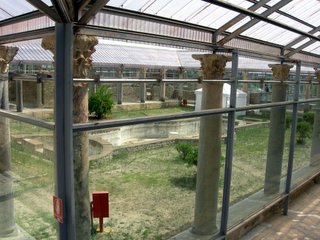
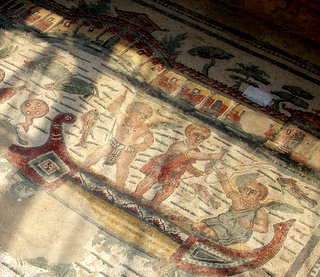
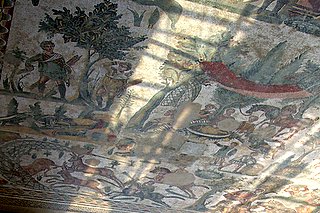
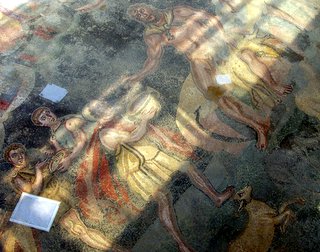
| Afterwards we drove to Villa Romana del Casale just outside Piazza Armerina. This villa was considered one of the artistic treasures of Sicily for its magnificent floor mosaics. It had been buried under mud for almost 700 years until being uncovered in 1929. The villa�s mosaics were discovered in the 1950�s. This large, lavish Roman villa, built in the early 4th century AD, belonged to one of the Roman aristocratic families, most likely Maximianus Erculeus. Many corridors surrounded its central courtyard, and there were a total of forty rooms in the villa. Its entire floor space was covered in rich colored mosaics with each corridor and room in the villa displaying a different theme. Some told stories, some displayed African themes, and many involved different aspects of hunting. Most remarkable was the �Corridor of the Great Hunt.� |