September 10, 2008
Our arrival in Malta on Sunday, August 3, marked our halfway point across the Mediterranean. This small island group, with a total area of just 122 square miles, consisted of three islands: Malta, Gozo, and Comino. Due to its excellent natural harbor and strategic location between Africa and Europe, Malta had seen many invaders and colonizers over the centuries, making it a fascinating historical place to visit. Between 3600 to 3000 BC, a prehistoric civilization left its mark on the islands in the megalith temples and amazing underground tombs that they built. In later years, other groups (in historical chronological time) arrived: the Phoenicians, the Romans, the Arabs, the Normans, the Knights of St. John, the French, and the British. The Maltese language is said to be a blend of Arabic and Phoenician; its sounds are foreign to any other language that we have ever heard. Like the British, the Maltese people drive on the left hand side of the road, and English is the second official language of the islands. In 1964, Malta became independent. In 2004, it joined the European Union.
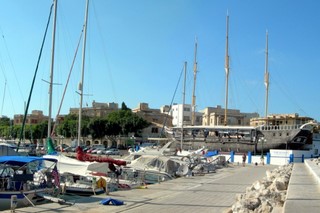
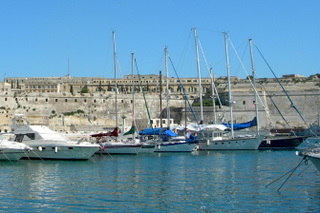
During our stay in Malta, we moored at Msida Marina. On Monday we immediately tackled our fuel tank problem. First, Phil took up the floor boards, a major project. He assumed that the screws of the inspection plate hadn�t been tightened by the people who had made the tank, causing the full tank to leak during our sail from Greece to Malta; upon checking, his deductions proved correct. Luckily it wasn�t anything more, but the project did entail an entire day, and by the end of the project Phil was exhausted. At the marina, we had a view of both the Black Pearl Restaurant, originally a square-rigged ship used in the making of the film Popeye (not Pirates of the Caribbean, even though the ship has the same name) and of the walls of Valletta, the town created by the Knights of St. John in the 16th century. |