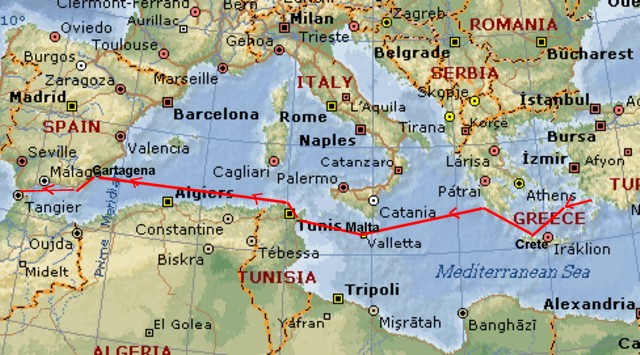
Departing Marmaris, our route took us first to Symi, where we checked into Greece, and then to Rhodes (Rodos), our first �must see� port. Our main reason for stopping in Rhodes before starting our journey across the Mediterranean was to visit the medieval fortified town founded by the Knights of St. John in the 14th century, as last year we had visited their castle in Bodrum, Turkey. In the 11th century, merchants out of Amalfi, Italy, had set up a hospital and guesthouse for poor pilgrims in Jerusalem, and it was from this beginning that the Knights of St. John evolved during the Crusades. Originally known as the Knights Hospitaller of St. John of Jerusalem, the Order grew over time into a military order, offering not only hospitals to pilgrims en route to the Holy Land but also protection. When Muslims gained control of the Holy Land in 1291, the Knights were forced to leave, resettling in Rhodes in 1306. The Knights� members consisted of Catholic noblemen from basically five nationalities: Italy, France, England, Germany, and Spain. Each nationality lived and dined in separate quarters, and each group protected a different area of the town�s walls. At the head of the Order was the Grand Master, elected for life. The Knights lived in Rhodes for over 200 years, withstanding two great sieges by the Turks in 1444 and 1480, before succumbing in 1522 and being forced to leave the island.
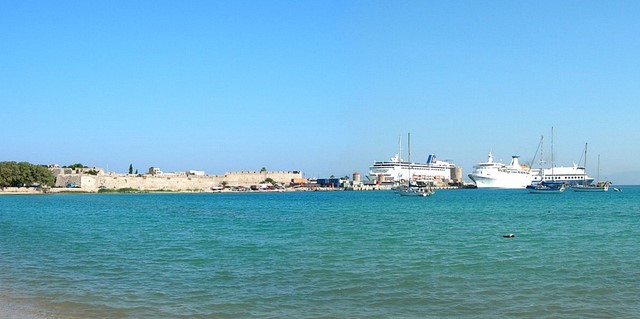
During our stay in Rhodes, we anchored in the same harbor as most of the cruise ships. Rhodes� old medieval town was impressive surrounded by massive walls, up to 40 feet thick. Especially interesting was the Knights� Quarter, situated near the waterfront inside the medieval town. The Street of the Knights, where the knights had once lived, was lined with the various Inns of the Knights that had comprised the Order. Above some inns could still be seen the crest of that individual group. At the far end of the street lay the Palace of the Grand Master, a fortress itself, which in times of battle became the last refuge for the entire Rhodes population. The sheer size of the palace was best seen from the waterfront. Most of the restoration work we saw occurred during the Italian occupation under Mussolini in the first half of the 1900�s. |