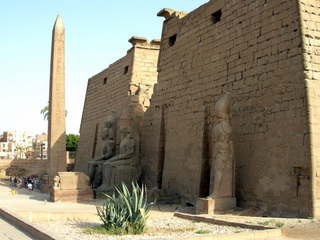
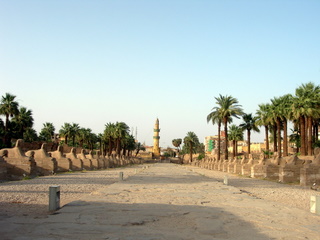
| After lunch and a restful afternoon onboard our cruise boat, we reconvened at 5 pm to visit Luxor Temple. This temple had been begun by Amenhotep III in the 14th century BC and completed by Ramses II in the 13th century BC. Like Karnak Temple, it was dedicated mainly to Amun-Ra. The pylon forming the fa�ade of the temple had been built by Ramses II, and in front were two colossal statues of him and one obelisk (the other had been given as a gift to France). Outside the entrance to the temple lay the Avenue of Sphinxes. In ancient times, this avenue joined Luxor Temple to Karnak Temple, 1.2 miles away. Processions between the two temples must have been impressive. |
 |
 |
 |
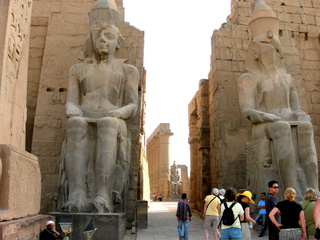
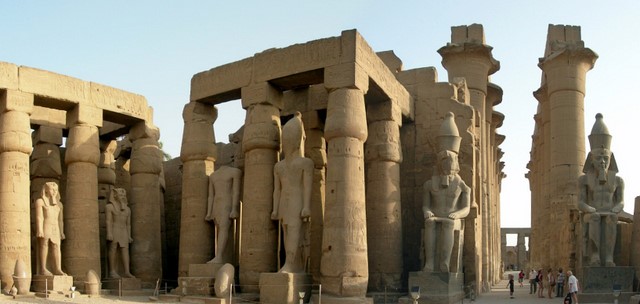
| Just inside the pylon was the Court of Ramses II. Besides the standing statues of Ramses II, there were two seated colossal statues of him. They were impressive! Both were wearing the double crown for a unified Egypt, and both displayed the false beard, the symbol of royalty. Underneath each seated statue were two reliefs: the top relief showing the Nile god Hapi tying the knot between Lower and Upper Egypt (indicating the unification of Egypt) and the bottom relief showing Ramses� enemies (the Hittites and the North Africans) as his slaves. The significance of Ramses II being seated over both acknowledged that he was ruler over all; his feet on top of his enemies denoted he was stepping on them. |
 |
| Page 5 |