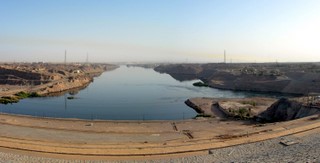
| Monday we enjoyed the sights of Aswan, Egypt�s most southern city. First, we visited Aswan�s High Dam. Aswan Dam, the initial dam, had been built by the British and opened in 1902, but it was unable to restrain the Nile River�s erratic flooding. Hence another dam, the High Dam, was built by Nasser in the 1960�s with the help of the Soviet Union. When it opened in 1971, this dam provided enough hydroelectric power for Egypt�s entire population of 20,000,000 people. Unfortunately, since then, Egypt�s population has quadrupled, and this is no longer the case. |
 |
| Prior to the building of the dams in Egypt, the annual flooding of the Nile took place during the summer (the monsoon season at the Nile River�s source in Uganda). During this time, farmers grew their crops fertilized by the Nile River�s rich silt deposits. With the building of the two dams, Egypt�s cultivable land increased and crops were able to be grown three times a year instead of just once. But without the annual flooding, the farmers have had to resort to artificial fertilizers, causing some controversy among Egyptians.
The High Dam�s opening also created Lake Nasser, the largest artificial lake in the world. Its formation caused the relocation of 800,000 Nubians, including 52 Nubian villages. Many of the Nubians resettled in Aswan. Since the time of the pharaohs, this African tribe had called the area south of Aswan their home until the construction of the High Dam. In addition, 14 Egyptian temples became submerged when the lake was filled. Starting in 1972, the international community, led by UNESCO, dismantled each of the 14 temples using cofferdams and then reassembled them elsewhere. |
| Page 15 |