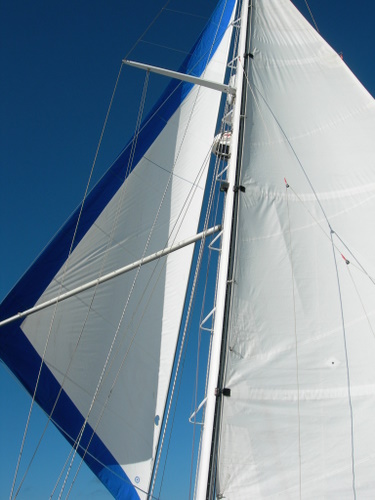
| January 31, 2009 Sunday afternoon, January 4, we departed the Canary Islands for our passage across the Atlantic to Antigua in the Caribbean, 2700 miles away. We left from San Sebastian in La Gomera, the exact same place from which Christopher Columbus departed on his first voyage across the Atlantic in 1492. Our first 7 days out were mostly idyllic, just right for two �old mariners� enjoying perhaps their last major ocean passage. After passing the lee of La Gomera, we enjoyed a brief 15 hour sail with winds NE 20 knots before encountering lighter winds. Except for interludes of variable winds or squally periods, we enjoyed a sail for 6 days on a starboard broad reach with winds N to NNE 8-15 knots and seas less than 6 feet. During much of this period we encountered beautiful days and moonlit nights, sailing mostly on a wing-on-wing configuration with poled out jib. When the winds were 8 knots or above the sail was most comfortable; with less consistent wind the boat had more motion. During the week we enjoyed all of our meals out in the cockpit. |
 |
| Since departing La Gomera, we had been sailing a course of 240 degrees true. Our plan was to head toward [20 N, 30 W] until we were able to pick up the easterly trades. Early Sunday morning, January 11, we picked up the trades slightly earlier than expected, and so changed our course and headed west toward Antigua, 1798 miles away. For the next two weeks we sailed with easterly winds (ENE to ESE) until our arrival in Antigua. With the wind directly aft, the sail technically became a downwind sail, one of the most difficult points of sail to be on due to the possibility of jibing, especially in our cruising wing-on-wing configuration. Hence, it became important to bear off from our intended course in order to take into consideration the yaw of the boat due to the sea conditions. Basically the greater the seas, the more we needed to bear off. Only for brief periods when the wind veered more NE or SE did we actually sail our intended course. Mostly, we just zigzagged our way across the Atlantic, sailing on a broad reach. With the wind behind us, we began to surf the seas. Sunday morning we put our self-steering vane into �commission� as we expected the winds and seas to start increasing Monday according to our �weatherman�, Phil�s brother. We had been using our auto pilot to steer the boat, but now felt that the wind vane would do a better job as it followed the wind in contrast to the auto pilot which steered a compass course. As the wind vane allowed for wind shifts, it permitted us to sail closer to our intended course while reducing the possibility of jibing. Also, we felt that our wind vane would be better in handling the predicted higher seas because the auto pilot used more battery power in those conditions. |
| Page 1 |