| July 5, 2004
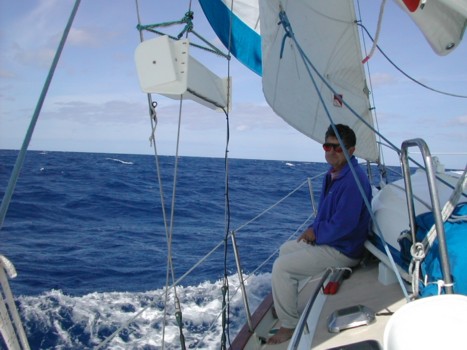
The passage from Bermuda to the Azores was a mixed bag of wind and sea conditions. The Azorean and Bermuda highs that usually are prevalent this time of year were just not there. Instead, there were quite a few fronts coming off the north American coast. For the first part of this passage we stayed south of these lows. We started this passage with a new moon and ended with a full moon. During this passage we also wore sweats for the first time to keep warm. Our first three days we sailed a broad reach. Friday, June 18, and Saturday, June 19, the winds were WSW to SW 15-20 knots, seas 6 feet, and at times KUHELA was surfing down the following seas. On Sunday the wind increased to SW 21-23 knots, seas 8-10 feet, and now KUHELA was really surfing. This wasn�t a comfortable motion as the boat did a lot of rolling. The first two days we sailed with a reefed main and poled-out jib. When the wind picked up, both sails were reefed even further. Monday through midday Wednesday saw winds fluctuating from 4 to 11 knots, coming first from the north on Monday and swinging around to the south by Wednesday morning. Seas were mostly 2 feet. When the winds were light and variable, we motorsailed or even just motored. It wasn�t until Tuesday that we had our first blue sky day. Before that, the days were overcast, sometimes with light drizzle, and dampness permeated the cabin. What a wonderful feeling it was to finally have the cabin dry again. By midday Wednesday, the wind was 16-18 knots SSW with another low forecasted. During the day we enjoyed � to 1 knot favorable current. By Thursday morning the wind was 17-21 knots SSW, and the cloud cover had returned causing dampness once more inside the cabin. On Thursday morning, June 24, we noticed that the alternator had stopped charging the batteries. As the auto pilot was steering the boat at this time and needed battery power, we decided to switch to the self-steering vane. While engaging the self-steering vane a fitting broke rendering it inoperable. An hour later, after troubleshooting the problem, Phil fixed the alternator. During that hour, though, it occurred to us both that if he hadn�t been able to fix the alternator we might be steering full time, not a pleasant thought. By late Thursday evening we passed through the front, and the wind shifted back to the NE. On Friday the wind was still from the NE 12-15 knots, seas 4-6 feet, but now we were encountering for the first time a NW countercurrent of 1 to 1� knots. Our ability to tack was hindered by this countercurrent; we were �in transit to somewhere,� but definitely not to the Azores. On Friday we made only 94 nautical miles toward our destination. |
 |
| Page 1 |
| Mid Alantic Ocean |