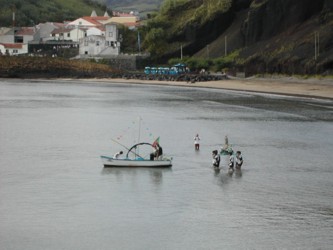
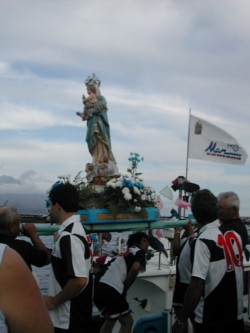
| Most memorable was the festival of Nossa Senhora da Guia, the protector of the fishermen. This started with fishing boats carrying the honored statue of Nossa Senhora da Guia from one side of Horta to the main wharf where a blessing was then given by the priest. Next, the solemn procession continued to the church accompanied by two village brass and woodwind marching bands (called filarmonicas). As we watched the procession, it seemed like everyone was swaying back and forth in unison to the beat of the music, a most endearing scene |
 |
 |
| The evening entertainment during Sea Week took place on one of the four stages set up for the weekly event with different groups playing at 9 pm, 11:30 pm, and 1 am. The main nightly performance always took place at 11:30 pm on the main stage located at the marina. On Sunday night we heard the beautiful singing by the Portuguese singer �Vitorino�.
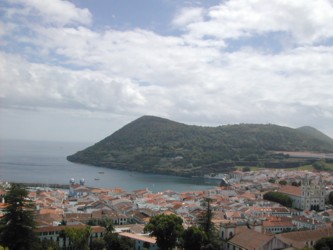
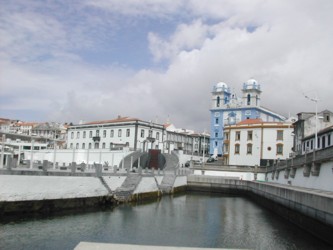
Monday afternoon, August 2, we departed Horta and sailed overnight 73 nautical miles to the town of Angra do Heroismo on the island of Terceira. This historic regal town captured our hearts with its beautiful 17th and 18th century architecture and delightful people who were so very proud of the great role their town had played in Azorean and Portuguese history. Angra was the first settlement in the Azores to gain the status of town, the last Portuguese territory to submit to Spanish rule, the first capital of the Azores, and in Portuguese history an important Liberal stronghold during the struggle between the Liberalists and the Absolutists. For its role, Angra was renamed �Angra do Heroismo� for its �demonstration of patriotism and spirit of sacrifice.� |
 |
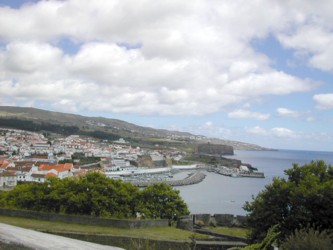 |
| The marina at Angra do Heroismo was built at the footsteps to the �original doors� of the city, symbolically represented by arches. Each day as we entered the town through these arches, it was exciting to think that these same arches were walked under by sailors of an earlier era when Angra�s harbor was a major port of call to many ships. Because of our travels to Cartagena, Colombia, it was interesting to realize that the Spanish armadas returning with treasures from the New World stopped in Angra during the 17th century to regroup before heading to Cadiz, Spain. This was due to the many pirates off the North African coast. |
 |
| Page 6 |