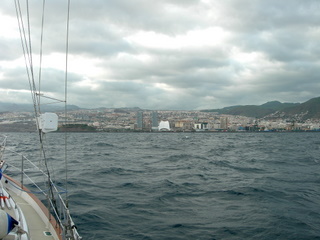
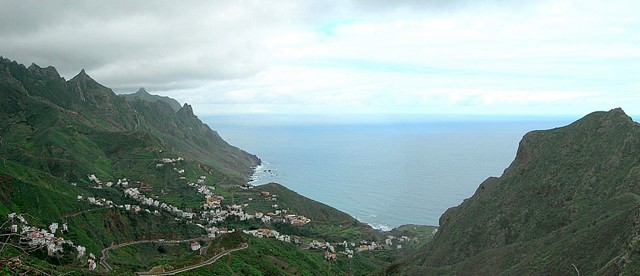
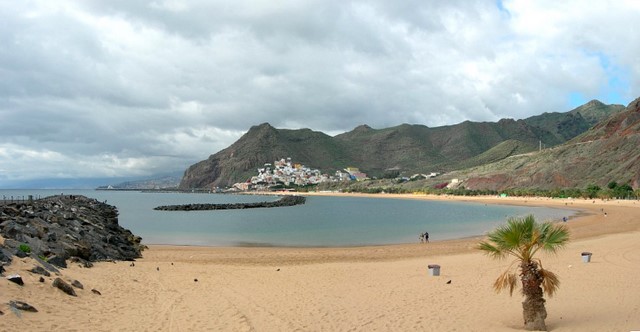
Tenerife, the largest Canary Island, was also the most populated island. Its capital, Santa Cruz, was the second largest city in the Canaries after Las Palmas. The island of Tenerife was quite beautiful with dramatic, contrasting scenery. At its center, towering above all at 12,198 feet, was the volcano El Teide, the highest mountain in the Canaries and in all of Spain.
Here, just like in Gran Canaria, we rented a car with our friends, Imke and Uli, to explore the island. We first drove northeast through the rugged Anaga Mountains, then southeast to Puerto de la Cruz and the fertile Orotava Valley, and afterwards up to Teide National Park with its impressive volcanic landscape. On our way to El Teide, we stopped and walked around La Orotava�s quaint historical district with its traditional Canarian architecture. A life-size Nativity scene completely surrounded its main square. During much of our drive we had limited views due to cloud cover, and while in Teide National Park we never did get to see El Teide. Sometimes, we even got caught in the thick of the clouds and had almost zero visibility. |