 |
|
|
|
|
|
|
|
|
|
|
|
|
|
|
|
|
|
|
 |
|
|
 |
|
|
|
|
Finesse Fishing - The Texan Way |
|
|
|
|
|
|
|
By: Phil Addison |
|
|
|
|
|
|
|
|
 |
|
|
|
|
|
|
|
|
Have you ever had one of those days where you've thrown everything but the kitchen sink? Nothing has worked and you've decided it's time to go home and see "Momma". If you say no, then you must be one of those true top-notch professionals in their own mind! The next time you experience a trip such as this you might want to give this technique a try. What is it? It's called "wacky worming". This method is quickly becoming the most popular and one of the best producing methods of catching quality fish in East Texas. I can accredit two of my largest bass caught and two tournament wins by using this technique. Chances are this method will produce on your own favorite lake or stream. The reason being is simple. It is a finesse type of fishing that doesn't require finesse type equipment and is very easy to fish. Another plus is that one can actually cover a lot of area in a short period of time once you become experienced with it. |
|
|
I have no idea where this technique originated from, but I have heard through the grapevine that it originated at Toledo Bend some 20 years ago. A couple of "Winter Texans" were down doing their crappie fishing thing and decided they wanted some bass action, especially after hearing of a guide on the lake talk about how many fish he was catching. With the crappie fishing being slow, the two "Yanks" graciously asked the guide what they were feeding on and he promptly showed the two the worms that he had been using. The two "Yanks" bought a couple of bags of the worms and they were off to do some bass fishing the next morning. Not knowing how to rig the worms, the two figured the plastic worm was hooked as though it was live bait. When the two returned to the marina later that day, onlookers were amazed by their catch. To say the least, a new technique had accidentally evolved from the two inexperienced anglers. This technique was later to be known as "wacky worming". |
|
|
|
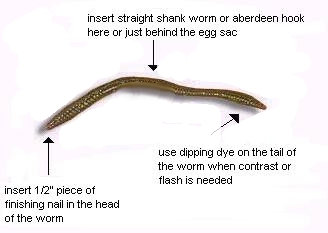
The wacky worm is nothing more than a straight worm with a small hook inserted through the center of the worm or just behind the "egg sac". A weight such as a �" piece of finishing nail is then inserted in the head of the worm. Any straight worm will work, but my favorites are the Lake Fork Twitch Worm and Zoom Trick worms. Other popular manufacturers of the straight tail worm are Gene Larew, Creme, Berkley, Reaction Lures, and Mister Twister Exude. Lake Fork Ring Fries and other centipede type worms work well at times, especially when "downsizing". The color to purchase and use are the colors that are popular on your lake, river, or stream. In my region of the country, all watermelon colors and red bug works well. |
|
|
|
 |
|
|
|
|
The hook type should be a straight shank type worm hook or a crappie hook (Aberdeen). The hook should be small enough that it does not impede the action of the bait. Therefore, I use an Owner 2/0 Aberdeen hook about 90% of the time. Gamakatsu also makes a terrific hook for wacky worming, but I favor the Owner because the wire of the hook is a little stronger than that of the Gamakatsu. However, Gamakatsu makes the best hook with a weed guard. I favor it when using the wacky worm around brush wihch allows one to penetrate the center of the cover with less hang-ups. |
|
|
|
|
|
|
Using the "wacky worm" can be frustrating to the beginner. This is due to the number of "professional overruns" one might have while starting out due to the light weight of the bait. The key is to use quality equipment and that includes the line as well. A good baitcaster such as a Shimano Curado and a medium action rod of your choice that is 6 to 6 � feet long will get you started in the right direction. The rods that I use are the Falcon Cara (CC 3-166) and the Falcon "Weightless Worm Special (LFC 5-167). This is due to the sensitivity, backbone, and soft tips these rods have. Another excellent rod is the Falcon Expert Series (EC - 6M) rod. This rod is very good when accuarate casting is a must. One should never fish the wacky worm on line greater than 15lbs. in breaking strength. This is due to the diameter of the line and its castability with light tackle. The line I favor is 15 lb. P-Line Floroclear. It has a small diameter, flourocarbon coated that makes the line virtually invisible under the water, and has great casting characteristics. I also use 10 lb. or 12 lb. P-Line CXX Xtra Strong. P-Line CXX Xtra Strong also has good castability, but also has possibly the best abrasion resistance of the monfilament lines on the market. The P-Line CXX Xtra Strong gives me a great deal of confidence to horse a big fish out of tight cover. If you haven't tried P-Line, you need to do yourself a favor! |
|
|
|
Now that you own the right equipment and have purchased some straight tailed worms, you are ready for some fantastic action. The "wacky worm" can be fished shallow or deep just as you would fish your favorite Texas rigged worm. One of the most important things to remember is to be patient with the worm and allow it reach bottom before you start your retrieve. Ninety percent of the time, the fish will take the worm on the initial fall. Therefore, one needs to be aware at all times by watching for a slight, unusual movement in the line or feeling for a slight "tick". If the initial fall does not produce, hop or twitch the worm not more than twice before retrieving the worm and starting all over. Once you have detected that elusive bass on the other end of your pole set the hook with a quick snap of the wrist. There is no reason for a bone jarring, jaw breaking hook set. Remember that the hook is exposed and you will be using a lighter wired hook than normal. |
|
|
|
If you make "wacky worming" a part of your arsenal against one of the toughest species of fish to catch, I will guarantee you better results. These results just might pay off for you as they have for me. |
|