 x
100. Your point score will be a component of your final grade, as described
below.
x
100. Your point score will be a component of your final grade, as described
below.
| Course: | Introduction to Statistics - MAT 52-213 |
| Time and place: | TTH 9:30-10:45 room
TTH 1:00-2:15 room |
| Instructor: | Dr. Philip Owens |
| Office hours: | TTh 11:00-12:30 room and telephone
catch me right at 2:30 in my office; other times by appt. |
| e-mail: | [email protected] |
| Text: | The Active Practice of Statistics, David
S. Moore, W. H. Freeman, 1997
ActivStats Version 2.0 CD-ROM, Paul Velleman, Addison Wesley Interactive, 1998 |
| CD-ROM website: | http://www.datadesk.com/ActivStats/ |
| Tutoring: | http://www.southwestern.edu/academic/acser-tutor.html |
| My supervisor: | Prof. Gary Richter (863-1490) MBH 144 [email protected] |
Goals: Learn concepts and mathematics behind, and methods for carrying out, selected types of statistical analyses.
Resources: The primary teaching medium will be the lectures and demonstrations provided on the ActivStats CD-ROM. ActivStats has an excellent series of presentations that present the material and show you how to do the statistics involved. They get you actively involved in your own learning, and at your own pace (unlike the standard "blackboard lecture").
Learning modes: You will learn how to do many of the statistical analyses "by hand" using small data sets to make the analyses non-computational-intensive. You will learn as much of the mathematical background of these analyses as is feasible in a course taught at this level. You will also learn how to do the appropriate statistical analyses using the statistical package Data Desk (built into the ActivStats package) on larger data sets. Homework and tests will encompass both genres of statistical understanding.
Daily activity: When you arrive in class, you may write on the board the numbers of (1) practice problems due today, (2) the numbers of credit problems due last session. I will write out the solutions on the board. Class will then proceed with (1) H/W discussion (2) quiz over reading (3) "lecture" over the day's lesson (4) in-class exercises, as time permits (to be turned in for credit), or a chance to get started on the next assignment.
My role: Formal "lecturing" will be kept to a minimum. I will serve in the role of facilitator, mentor, guide, question-answerer and evaluator (grades). My "lecture" will highlight important points and and try to anticipate problems you might have with the exercises.
Examinations: There will be 3 tests and a comprehensive final exam (see the Schedule). A missed test will count as a 0. There will be no make-up tests, but I will replace the grade on the weakest of the 3 tests by the grade on the final. There is no provision for more than one missed or botched test.
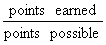
Points: Homework (5 points per question), quizzes (5 points each),
and in-class exercises (5 points) will count toward your "point score",
which will be computed as x
100. Your point score will be a component of your final grade, as described
below.
Project: There will be a course research and writing project, which will help bolster the grades of persons of a non-technical inclination. The due date will appear in the schedule when decided on.
Homework exercises:
There will be two sets of exercises for you to do:
(a) Practice exercises (answers in the back of the book). You will not turn these problems in.If you are doing a conscientious job on the practice problems, you should fare well on the credit problems. If you are simply looking in the back of the book to see what the answers are for the practice problems without trying them first on your own, you probably won't be able to answer the credit problems correctly.
(b) Credit exercises (no answers). These will be turned in for grading and credit (5 points each)
You will be allowed 3 late homeworks at no penalty, which must be submitted before the next test. After you have used up your lates, you may still turn in your lates for evaluation by me, but they will not count.
Homework reading: Go through the ActivStats presentation (supplemented by the text) of the next session's lesson in advance (see the schedule for when each lesson will be discussed). You must go through it with enough understanding to be able to answer a quiz question over it (5 points) during the next class session. Quizzes cannot be made up, but missing a couple will have a negligible effect on your grade.
Grading: Your final grade will be computed as follows:
45%: tests 1-3 (with the weakest grade replaced by the final grade)If you are a borderline case (between major letter grades, like A and B), I may consider: attendance, class participation, improvement, and attitude.
20%: point score (homework, quizzes, in-class work)
15%: project
20%: final exam
The letter-grade scheme is: 97-100 A+, 93-96 A, 90-92 A-. Note that e.g. a 96.99 is still "just" an A (no rounding up!). The B's are in the range 80-89, C's 70-79, D's 60-69, and F's below 60.
Interim progress reports: Attached to each test will be a slip
of paper with the following numerical entries on it:
| overall
average |
test
average |
point
average |
your
points |
points
possible |
effective
date |
Please check these numbers against your own records, as clerical errors can occur. Note:
overall average (before project due date) = .80 ´ (test average) + .20 ´ (point average)Technology: You will need a scientific calculator (has a log key) for doing computations by hand. A graphing calculator is not necessary, but I will discuss using one for statistics if there is a demand for it.
Attendance: Attendance is important, since in-class work and quizzes (for points) cannot be made up. If it is your intention to drop the course, don’t just stop attending. It is your responsibility to drop yourself through the Registrar’s Office. If your class record is otherwise satisfactory, but your grade is threatened because of a missed exam due to a personal emergency, please feel free to discuss this with me (by phone or in my office; please, not in the classroom).
Tardiness: Please exhibit a positive attitude toward your classmates, your instructor, and the course by arriving on time for class. I will commence exactly on time, and it is disruptive to have students entering after class has started. You may be penalized for chronic, unexcused tardiness. Please discuss with me (in advance) any problems you might have with this policy, to avoid being penalized.
When to seek extra help: If you are having difficulty with homework, quizzes, tests or class work, please see me immediately, or go to Tutoring for help.